The good news: HR automation tools that once only made sense for large enterprises are now built for teams this size, at prices small businesses can afford. These platforms handle payroll, onboarding, and compliance tracking automatically, freeing up hours every week for the person wearing the "HR" hat.
Software can't do everything, though. Configuring these tools well, interpreting compliance requirements, and building a retention strategy still benefit from real HR expertise, not just a dashboard.
TL;DR
- HR automation software centralizes employee data, automates onboarding, and flags compliance gaps
- Small teams (10-100 employees) without dedicated HR staff benefit most
- Top tools: Gusto, BambooHR, Rippling, Deel HR, and HiBob
- Choose based on your actual pain points, not feature lists or brand popularity
- Software handles process automation; strategic HR decisions still benefit from expert guidance
Overview of HR Automation for Small Businesses in the US
HR automation software replaces manual, repetitive HR tasks—onboarding paperwork, PTO approvals, and compliance tracking—with automated workflows and self-service tools. For small teams running lean without a dedicated HR department, those chores eat hours and raise the odds of missed deadlines or compliance gaps.
The US HR software market was valued at $14.8 billion, according to Forbes Advisor. Worldwide SMB software spending is projected to grow at a 13.3% CAGR through 2028, per Gartner's forecast. As remote and hybrid work add compliance complexity, more small businesses automate HR instead of managing every form and policy by hand.
Below are five platforms built with small business budgets and needs in mind.
Top HR Automation Tools for Small Businesses
Use the same scorecard for every vendor so demos stay comparable. Prioritize:
- Transparent pricing (base fee + per-person costs)
- Fast setup without a full-time HR admin
- Automation depth beyond simple reminders
- Integrations with payroll, benefits, and your existing stack
- Verified user ratings (G2 is a solid benchmark)
Below are five strong options for small teams, with pricing signals, standout features, and best-fit use cases.

Gusto
Gusto is a payroll-led platform built for small businesses that need tax filing, benefits, and onboarding in one place. Teams without a dedicated HR hire can usually get running quickly, and its AI assistant handles common payroll and HR questions on demand.
| Pricing | Key Features | Best For |
|---|---|---|
| Simple: $49/mo + $6/person; Plus: $80/mo + $12/person; Premium: $180/mo + $22/person | PTO policies, time tracking, performance management, custom reports, certified HR experts (Premium) | Small businesses that want payroll-first HR with solid compliance support |
BambooHR
BambooHR combines onboarding, recruiting, time-off tracking, and performance tools in a single HRIS. It targets companies with 1–100 employees, so it fits small teams that have outgrown spreadsheets but are not ready for enterprise complexity.
| Pricing | Key Features | Best For |
|---|---|---|
| Core: $10/employee/mo; Pro: $17/employee/mo; Elite: $25/employee/mo (from $250/mo flat for ≤25 employees) | Employee records, hiring/onboarding workflows, compliance intelligence, AI Assistant | Teams that want one platform for HR ops, hiring, and reporting |
Rippling
Rippling combines HR, payroll, IT, and workflow automation in one customizable system. With 600+ integrations and a custom workflow builder, it suits teams that expect to grow across states—or eventually countries—and want HR and IT tied together.
| Pricing | Key Features | Best For |
|---|---|---|
| Custom quote; Forbes Advisor cites ~$8/user/mo starting | Payroll, benefits, time and attendance, recruiting, PEO, custom workflows | Growing teams that want HR and IT automation in one system |
Deel HR
Deel HR is a global hiring and HR platform with a modular HRIS. You can add compensation, recruitment, or compliance modules as you expand—without ripping out the core system.
| Pricing | Key Features | Best For |
|---|---|---|
| $5/user/mo | Worker profiles, org charts, time off, approvals, workforce reporting | Small teams hiring contractors or employees across multiple countries |
HiBob
HiBob is an HRIS built around engagement, culture, and performance, with core HR and payroll functions underneath. Choose it when you want the system of record to double as a culture and engagement hub—not only an admin database.
| Pricing | Key Features | Best For |
|---|---|---|
| Quote-only, tiered by company size | AI Companion, employee database, lifecycle workflows, analytics, mobile app | Teams that want engagement tracking alongside core HR |
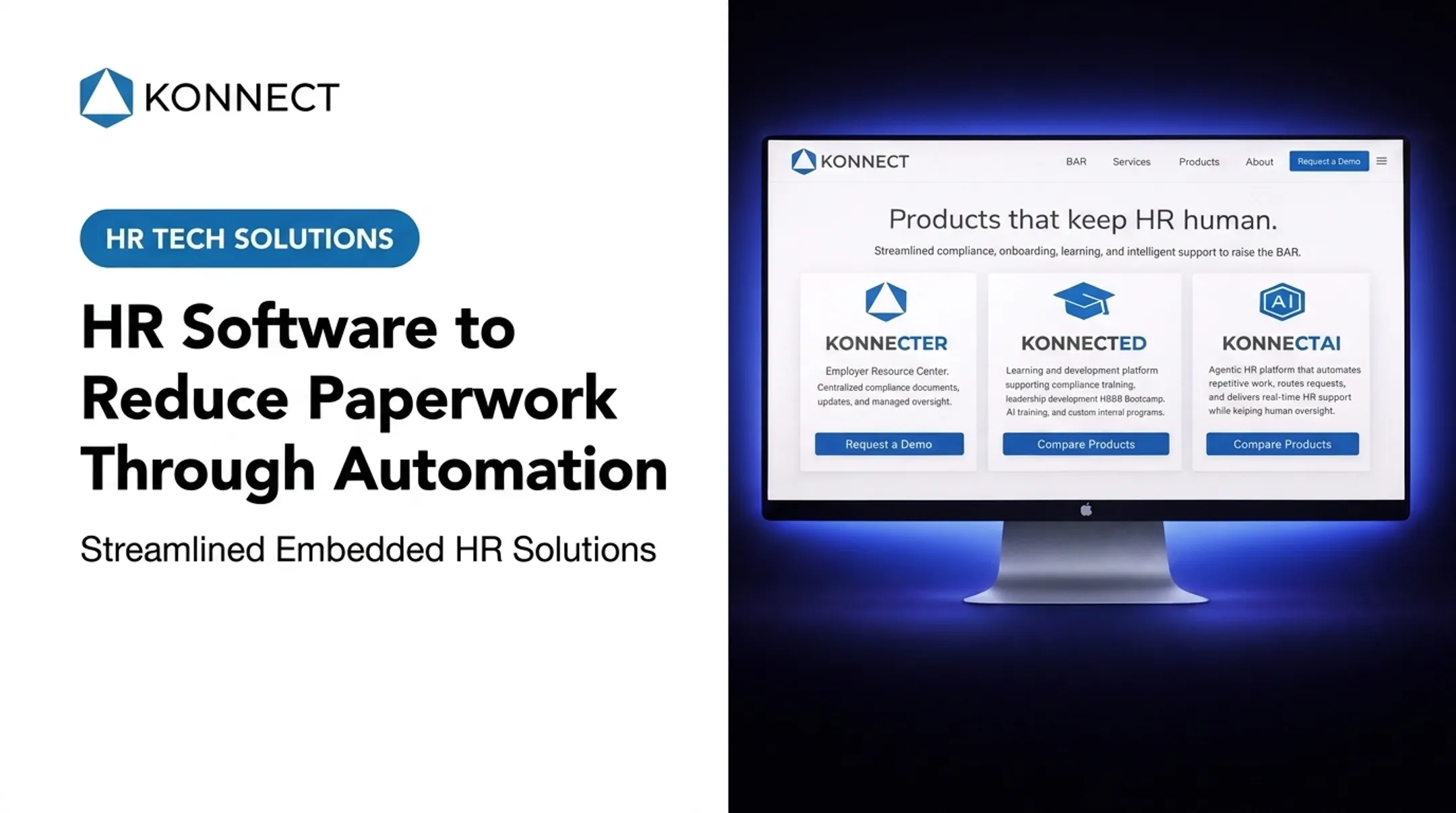
Match the tool to your must-have workflows first (payroll, hiring, multi-state compliance, or engagement), then confirm implementation ownership. Many small teams pair software with fractional HR support—such as Konnect’s advisory and KonnectAi automation—so policies, approvals, and reporting stay consistent after go-live.

Key Features to Prioritize When Choosing HR Automation Software
Not every feature matters at every stage. Focus on:
- Core HR operations: centralized employee records, onboarding workflows, self-service portals for pay stubs, PTO, and policy access
- Automation and AI: automated reminders, compliance monitoring, and flagging retention risks before they become resignations
- Integration and scalability: payroll and ATS integrations, mobile access, and pricing that scales predictably as headcount grows
Common mistake: Buying enterprise-tier features (advanced analytics, global payroll, custom workflow builders) before you actually need them. Start with core needs—onboarding, PTO, and employee records—then layer on automation as your team grows.
Signs Your Small Business Needs HR Automation
You probably need automation if you're seeing:
- Time drain: PTO tracking, onboarding paperwork, and policy questions eat hours every week that should go toward growth
- Scattered data: Employee records live across spreadsheets, email threads, and shared drives, creating real compliance exposure
- Growth strain: Onboarding and HR processes that worked at 10 employees break down at 30, when one person can no longer track everything manually

If any of these sound familiar, evaluate tools now rather than after a compliance gap surfaces.
How to Choose the Right Tool (and When to Bring in Expert HR Support)
Evaluate software against your actual pain points, not a checklist of features. If payroll errors are your problem, that points toward Gusto. If onboarding delays are the issue, look at BambooHR's workflow automation. Software handles the workflow. It doesn't handle strategy. Decisions that still need experienced HR leadership include:
- Interpreting new state compliance requirements
- Designing benefits plans that fit your budget and workforce
- Building a retention-focused culture A dashboard alone won't cover those calls. Konnect works alongside your automation tools rather than replacing them. Its leadership team includes HR executives who've held CHRO and VP-level roles at companies like Forever 21, Chipotle, and UCI Health. The advisory model covers compliance support, people strategy, and retention-focused programs software can't deliver on its own. KonnectAi integrates with systems like ADP, Workday, and Paylocity, so you can escalate to a human when a situation needs judgment—not just another workflow.

Conclusion
The right HR software solves your actual operational pain points, whether that's payroll accuracy, onboarding speed, or compliance visibility. Feature lists and brand names matter less than practical fit for your team.
Start with one or two high-impact automations. See how they perform. Revisit your setup as your headcount grows past what any single tool or person can handle alone.
If you're ready to pair the right technology with hands-on expertise, Konnect's Center of Excellence model combines HR strategy, compliance support, and culture-building guidance with the automation tools already covered here.
Frequently Asked Questions
What is the best HR management software for small businesses?
It depends on your priorities. Gusto works well for payroll-first needs, while BambooHR and Rippling offer broader HR operations for teams wanting onboarding, reporting, and workflow automation in one place.
What is the best free HR software for small businesses?
Most reputable platforms don't offer permanently free, full-featured plans. Gusto, BambooHR, and Rippling offer free trials or setup periods, but check limitations before relying on a free tier long-term.
How can I automate my HR processes?
Start with one high-friction process, like leave requests or onboarding paperwork. Choose a tool sized for your team, get it working well, then expand to other workflows gradually.
Do small businesses need both HR operations and talent management tools?
Many small businesses combine a core HRIS for compliance and payroll with lighter talent tools for performance and engagement tracking. You don't always need both from day one.
How much should a small business spend on HR software?
Published pricing for the platforms above ranges from $5 to $25 per employee per month, depending on features. Costs scale up as you add modules like performance management or benefits administration.
How does AI improve small business HR automation?
AI reduces manual admin by sending automated reminders, flagging compliance issues, and answering routine employee questions instantly, cutting down on repetitive back-and-forth for HR-of-one teams.