Federal law sets a floor. Title VII, the ADA, the FLSA, and the FMLA give every employer a baseline. But California, New York, and Illinois now require far more, and 2026 is bringing another wave of changes for employers to track, from new paid leave programs launching in Delaware and Minnesota to AI hiring notice rules in Illinois.
This guide breaks down which handbook policies are legally required, which vary by state, and how growing companies can build a defensible handbook without burning resources on unnecessary complexity.
Key Takeaways
- State laws increasingly exceed federal minimums, mandating anti-harassment, paid sick leave, and pay transparency policies
- Multi-state employers typically choose a "most generous state" policy, state-specific addendums, or a hybrid model
- A signed acknowledgment isn't always required by law, but it's a strong defense against wrongful termination claims
- Review handbooks annually, ideally with HR or legal support, to stay current with 2026's state law changes
Core Policies Every Handbook Needs, Regardless of State
Some policies aren't optional. They're the backbone courts and regulators expect to see in any handbook, no matter where your company operates.
EEO and At-Will Employment Statements
Your Equal Employment Opportunity statement should confirm compliance with federal, state, and local anti-discrimination laws and affirm that employment decisions are merit-based. This isn't boilerplate — regulators check for it.
The at-will disclaimer needs prominent placement and precise wording. Get the phrasing wrong and you risk creating an implied contract you never intended.
One critical exception: Montana doesn't recognize at-will employment the way other states do. Under its Wrongful Discharge from Employment Act, employees who complete a probationary period (12 months by default, up to 18 months if written) can only be terminated for good cause.
Handbook language that promises specific discipline steps can become binding there, so disclaimers need extra care if you have Montana employees.
Anti-Harassment and Nondiscrimination Policies
A growing number of states legally require a written anti-harassment policy with specific elements:
- Clear definition of prohibited conduct
- Multiple reporting channels beyond "tell your supervisor"
- Explicit non-retaliation guarantee
- Defined investigation process
Several states go further and mandate periodic training on top of the written policy:
| State | Training requirement |
|---|---|
| California | 1 hour (nonsupervisors) or 2 hours (supervisors) every 2 years for employers with 5+ employees |
| New York | Annual interactive training for every employee, statewide |
| Illinois | Annual training for all employers |
| Connecticut | 2 hours for all employees at companies with 3+ staff |
| Maine | Training within the first year for employers with 15+ employees |
Record-keeping is the next frontier. New York City employers must retain training records for three years, and Maine requires the same. If your handbook doesn't reference how training completion gets documented, that's a gap worth closing before an audit finds it for you.
Reasonable Accommodation Policies
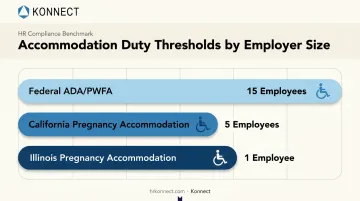
The ADA, the Pregnant Workers Fairness Act, and Title VII all require a written interactive process for disability, pregnancy, and religious accommodation requests. The PWFA applies at 15 employees, matching ADA coverage.
States often go smaller. California's pregnancy accommodation duty kicks in at just 5 employees, and Illinois extends its pregnancy accommodation requirement to employers with a single employee. If your handbook's accommodation language only reflects federal thresholds, your smaller offices or newly opened locations may be missing a policy the law already requires.
State-Mandated Leave and Time-Off Policies
Leave law is the fastest-moving compliance area in HR right now. A policy that's perfectly legal in one state can leave you exposed in the next.
Paid Sick Leave Variations by State
Most paid sick leave laws share a common accrual structure, roughly one hour for every 30 to 40 hours worked. Where they diverge is everything else: caps, coverage thresholds, and what counts as an eligible use.
| State | Coverage threshold | Annual cap |
|---|---|---|
| California | Employees working 30+ days/year | 40 hours or 5 days |
| New York | 5-99 employees (paid); 100+ (paid, higher cap) | 40 hours (under 100); 56 hours (100+) |
| Colorado | All employers | 48 hours |
| Arizona | Under 15 employees vs. 15+ | 24 hours (small); 40 hours (larger) |
| Michigan | 10 or fewer employees vs. larger | 40 hours (small); 72 hours (larger) |
That's a threefold difference between Arizona's small-employer cap and Michigan's standard for larger employers. A universal PTO policy built around one state's rules almost never satisfies another state's minimums.
Paid Family and Medical Leave (PFML) Programs
Fourteen states plus D.C. now run mandatory paid family and medical leave programs, according to a national tracker of state paid leave laws. These are state-run insurance programs that provide partial wage replacement, funded through payroll contributions rather than direct employer payment.
2026 brought new activity:
- Delaware and Minnesota benefits became available January 1, 2026
- Maine benefits launched May 1, 2026
- Washington's job-protection threshold began phasing down to employers with 25+ employees
Handbooks in these states need updated eligibility language, notice procedures, and coordination rules explaining how PFML interacts with FMLA and internal leave policies.
Other Required Protected Leave
Beyond sick leave and PFML, states layer on additional protected leave categories:
- Jury duty leave: protected almost everywhere, though pay isn't always required
- Voting leave: New York grants up to 2 paid hours when off-duty time isn't sufficient
- Military family leave: Illinois requires 15 to 30 unpaid days depending on company size, beyond federal USERRA protections
- School-activities leave lets Illinois parents take up to 8 unpaid hours per school year
Eligibility, pay, and notice timing vary state by state, and a general company PTO policy typically does not satisfy these mandates. Employers usually need a standalone compliant policy or a state-specific addendum rather than trying to fold everything into one PTO bucket. Konnect's compliance team builds these state-specific addenda directly into client handbook libraries, updating them as new leave laws take effect.

Wage, Hour, and Break Policies That Vary by State
Federal law doesn't require meal or rest breaks at all. That single fact catches a lot of multi-state employers off guard when they try to run one universal break policy nationwide.
Pay Frequency and Final Paycheck Rules
States set their own rules on how often employees get paid and how fast a final paycheck must arrive after termination:
| State | Final paycheck deadline | Penalty for delay |
|---|---|---|
| California | Immediately at discharge (72 hours if employee quits without notice) | Daily wage penalty, up to 30 days |
| Massachusetts | Same day as discharge | Mandatory treble damages |
| Colorado | Immediately, or within hours if payroll office is closed | Enhanced penalties after cure demand |
| Oregon | By end of next business day | Continuing wage penalty, up to 30 days |
Massachusetts's treble damages provision alone should make any employer with Massachusetts staff double-check their termination checklist.
Meal and Rest Break Requirements
The contrast here is stark. California requires a 30-minute unpaid meal break for shifts over five hours, generally by the end of hour five, according to California's Department of Industrial Relations. It also mandates a paid 10-minute rest break for every four hours worked. Compare that to Texas and Pennsylvania, where adult employees generally have no state-mandated break at all.
Employers with locations in both types of states face a choice:
- Build state-specific break policies that match each jurisdiction's minimum exactly
- Adopt the strictest standard company-wide, usually California's, to reduce litigation risk and simplify manager training
Most growing companies land on option two once they have even a handful of employees in a high-regulation state. The administrative simplicity tends to outweigh the extra break time. A pre-built multi-state handbook policy library, like the one Konnect maintains for clients in retail, healthcare, and hospitality, keeps these state-specific rules current without demanding a full-time internal compliance team.
Modern Workplace Policies to Add for 2026
Remote work, data privacy, and AI use aren't just operational questions anymore. They're compliance issues, and an outdated handbook that ignores them creates real legal exposure.
A compliant remote work policy should define:
- Core hours and availability expectations — when remote employees need to be reachable
- Equipment and home-network security requirements — VPN use, device standards, data handling
- Expense reimbursement — California, Illinois, and other states require reimbursement for necessary remote work expenses, including a reasonable share of home internet or phone costs
AI policy is newer territory but no less urgent. Illinois's employment AI amendments took effect January 1, 2026, adding notice and nondiscrimination requirements for AI used in hiring decisions.
A strong AI policy should require:
- Human oversight and bias review for AI tools used in hiring or performance decisions
- Clear notice to employees before AI factors into employment decisions
- Ongoing audits, not just a disclaimer that AI "may be used"
Colorado's broader AI accountability law was delayed to January 1, 2027, but that's a deadline to plan for now, not later.
Acceptable-use and data privacy policies round out the modern handbook. As more states pass consumer and employee data privacy laws, a handbook silent on data handling becomes a genuine legal liability.
Multi-State Compliance Strategy: Choosing the Right Handbook Approach
Employers with staff in multiple states generally pick one of three approaches:
- Single "most generous state" policy — Apply the strictest applicable rule company-wide. Simple to administer, but you'll exceed requirements (and costs) in states with lighter obligations.
- State-specific addendums — Keep a lean core handbook and attach state supplements as needed. Controls cost but adds administrative overhead every time a law changes.
- Hybrid model — A strong core handbook covering universal policies, paired with targeted state addendums only where requirements genuinely diverge (leave, breaks, pay frequency).

The hybrid approach tends to work best for companies between 20 and 250 employees: enough complexity to need structure, not enough to justify a full legal team dedicated to handbook maintenance.
One thing employers frequently miss: remote and traveling employees can trigger new state obligations. An employee who relocates to a different state, or spends significant time working from one, may bring that state's leave, break, and wage rules with them.
Handbook language should address where work is actually being performed, not just where the company is headquartered.
This is where having HR expertise on hand pays for itself. Konnect is led by HR executives with direct CHRO-level experience, including leadership roles at organizations like Forever 21 and UCI Health, and helps growing companies choose the model that fits their risk tolerance and budget.
Through the KonnectER employer resource platform, clients get:
- A centralized, multi-state policy library
- Ongoing alerts whenever federal or state employment laws change
- Support keeping the handbook current between formal reviews
Frequently Asked Questions
What legally needs to be in an employee handbook?
No federal law mandates that a company have a handbook at all. But if you have one, certain state-required elements, such as a written anti-harassment policy or an EEO statement, must be included depending on where your employees work.
Are employee handbooks legally enforceable?
Handbooks are generally not binding contracts when properly disclaimed as such. That said, courts can still hold employers to policies as written if they're applied inconsistently across employees.
Do all companies need to have an employee handbook?
While no law universally requires a handbook, having one is considered best practice for any company with employees. Some states require specific written policies regardless of company size, even without a full handbook.
Can I be fired for not signing an employee handbook?
In most at-will states, yes. Refusing to sign the acknowledgment can be grounds for termination, since signing is often a condition of employment. The underlying policies still need to be lawful, though.
Do multi-state employers need a different handbook for each state?
Not necessarily. Most employers use one core handbook with state-specific addendums, or apply the most generous state's rules company-wide, rather than maintaining a fully separate handbook per state.
How often should employers update their handbook for new state laws?
At least an annual review with legal or HR counsel is the standard recommendation. Beyond that, update immediately whenever a significant new law passes or the company expands into a new state.