For an owner already juggling sales, operations, and staffing, tracking all of this is a lot. Most small businesses handle HR themselves without formal training in employment law, which is exactly how simple oversights turn into costly violations.
This guide breaks down what HR compliance actually means in 2026, the legal areas you need to track, the mistakes that trip up well-intentioned owners, a practical checklist, and how to know when it's time to bring in outside expertise.
Key Takeaways
- HR rules span federal, state, and local levels—and some apply from your very first hire.
- Misclassification and outdated handbooks are the costliest compliance mistakes small businesses make.
- Review a documented compliance checklist twice a year to catch legal changes early.
- Software and outsourced HR support can cover compliance without a full internal department.
What Is HR Compliance and Why It Matters More in 2026
HR compliance is the practice of building and enforcing internal policies that align with federal, state, and local employment law. Done right, it prevents disputes before they start, covering everything from how you post a job to how you calculate a final paycheck.
Compliance isn't one-size-fits-all. Obligations phase in as your headcount grows, so a five-person shop and a 60-person company answer to very different rulebooks.
2026 raised the stakes:
- Minimum wage increases took effect in dozens of states on January 1, ranging from $11.41 in Minnesota to $16.94 in Connecticut.
- New paid leave programs launched in Delaware and Minnesota on January 1, with Maine's program following in May.
- AI hiring disclosure rules took effect in Illinois, requiring notice to candidates when AI factors into hiring, promotion, or termination decisions.
The financial exposure is real. A Hiscox claims study found that employment claims that reach defense and settlement cost businesses an average of $160,000. That figure covers legal defense plus settlement for a single claim.
At What Employee Count Do Compliance Obligations Kick In?
Federal law sets specific headcount triggers:
- 1+ employees: Equal Pay Act applies from your very first hire
- 15+ employees: Title VII, the ADA, and EEO poster requirements attach
- 20+ employees: The Age Discrimination in Employment Act (ADEA) applies
- 50+ employees: FMLA coverage begins, with a 75-mile worksite rule

State and local thresholds are often lower. California's harassment protections apply below five employees, and New York requires annual sexual harassment training from every employer, regardless of size. Check your state's rules no matter how small your headcount is.
Key Areas of HR Compliance Small Businesses Must Track
Compliance touches every stage of the employee lifecycle, from the job posting to the exit interview. Track these five areas and you cover the obligations that most often trip up small businesses.
Hiring, Onboarding, and Worker Classification
Anti-discrimination laws (Title VII, ADA, ADEA) apply the moment you start recruiting. Every new hire also needs proper paperwork:
- Form I-9 for identity and work eligibility
- Form W-4 and state withholding forms
- State-specific new-hire reporting
One of the biggest risks is misclassification. The IRS and DOL both use multi-factor tests weighing behavioral control, financial control, and the nature of the relationship—not just what you call someone on paper.
Calling a worker a "contractor" doesn't make it true if you control their schedule, provide their tools, and direct how they do the work.
Wage, Hour, and Leave Laws
The federal minimum wage has sat at $7.25 since 2009, but most states set their own, higher floor. You owe nonexempt employees overtime at 1.5 times their regular rate after 40 hours in a workweek, and accurate time records are non-negotiable.
FMLA applies once you hit 50 employees, but paid leave rules are moving faster than federal law. Delaware, Minnesota, and Maine all activated new paid family and medical leave programs in 2026, and dozens of cities layer on their own sick leave ordinances.
Workplace Safety and Recordkeeping
OSHA requires a visible Job Safety and Health poster in every workplace. Employers with more than 10 employees generally must maintain injury and illness logs. Industry-specific safety plans also apply in higher-risk sectors like healthcare and hospitality.
Retention matters as much as recordkeeping itself:
- I-9s: three years after hire, or one year after termination, whichever is later
- Payroll records: at least three years
- OSHA logs: five years after the calendar year they cover
Discrimination, Harassment, and Employee Relations
The EEOC enforces protections against discrimination and harassment, and enforcement isn't slowing down. The agency secured nearly $660 million in monetary relief in fiscal year 2025 alone. A growing list of states, including California, New York, Illinois, and Connecticut, now require recurring anti-harassment training, not just a one-time session at hire.
A documented, consistent complaint-investigation process is your best defense. Inconsistent handling of similar complaints is one of the fastest ways to lose a case, even when the underlying decision was reasonable.
Termination and Offboarding
Final paycheck timing varies dramatically by state. California requires immediate payment upon involuntary termination; Texas allows six calendar days; Massachusetts requires payment on an employee's last day if they're fired. Getting this wrong is an easy, avoidable violation.

Keep documentation, including performance write-ups, warnings, and investigation notes, for every termination. It's often the only thing standing between your business and a wrongful termination claim.
Common HR Compliance Mistakes Small Businesses Make
Most compliance failures aren't dramatic. They're small, everyday oversights that pile up.
Outdated or missing employee handbooks. A handbook written three years ago likely doesn't reflect this year's minimum wage, leave, or harassment-reporting requirements. An outdated handbook can actually work against you in a dispute, since it shows a policy existed but wasn't followed or updated.
Worker misclassification. This shows up two ways: treating employees as independent contractors, and misapplying exempt versus nonexempt status under the FLSA. Both mistakes trigger back pay, penalties, and sometimes employment tax liability.
Poor documentation habits. Skipped performance write-ups, missing complaint-investigation notes, and expired workplace posters are the details that get exposed the moment a lawsuit or audit happens. Solid documentation is your evidence when someone challenges a decision you made.
These gaps are exactly what a structured HR audit surfaces. Konnect's HR audit tool, the Konnect Score, evaluates businesses across eight compliance categories, including handbook quality, wage and hour practices, and anti-harassment measures. A score in the 60s isn't catastrophic, but it flags gaps worth fixing within 90 days, not 90 weeks.
HR Compliance Checklist for Small Businesses in 2026
Use this checklist as a living document, not a one-time exercise.
- Confirm required posters are current and displayed (including digital equivalents for remote employees who never see a breakroom wall).
- Reassess every worker's classification annually: check both exempt/nonexempt status and employee/contractor status.
- Audit your handbook against 2026 state law changes: update pay transparency, leave entitlements, and harassment-reporting provisions, then collect signed acknowledgments from every employee.
- Verify new-hire and offboarding paperwork: I-9s, W-4s, state withholding forms, and final paycheck timing all need to match current state law.
- Secure personnel files and complaint handling: confirm locked storage of records and a documented, consistent process for investigating employee complaints.
Review this list at least twice a year. Act on gaps as soon as you find them so small issues never turn into legal fire drills.
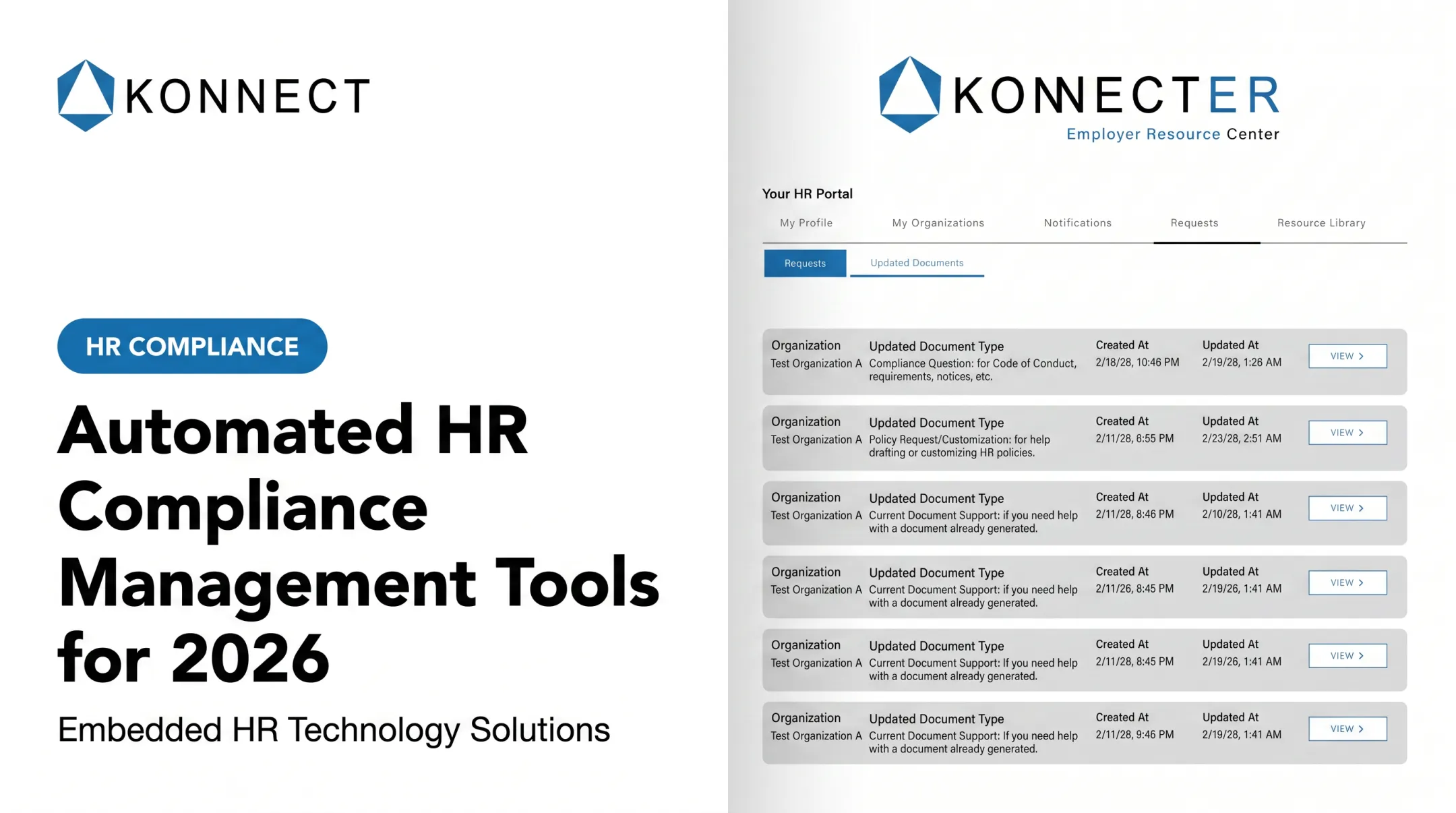
KonnectER, Konnect's employer resource center, centralizes handbooks, policy libraries, and compliance notifications in one place. That makes items 1, 3, and 4 far easier to keep current across multiple states.
Choosing the Right HR Compliance Support for Your Business
There's no single right answer for every company. The best path depends on your headcount, budget, and risk exposure.
In-house HR works best once you have the headcount and budget to justify a dedicated generalist or manager. It offers the most day-to-day control, but it's expensive to staff properly, and one person rarely covers every discipline, from compliance to recruiting to benefits, equally well.
PEOs and payroll software handle payroll tax, benefits administration, and basic compliance tasks efficiently. Where they typically fall short is strategic, executive-level guidance: they can process a termination, but they won't tell you whether your termination decision itself carries legal risk.
That gap is where a Center of Excellence model fits. Konnect is built around this approach under CHRO-level leadership, including founder Jamie Viramontes.
Jamie spent more than 25 years in HR leadership roles at Forever 21, UCI Health, and Chipotle. That background gives small businesses compliance judgment usually reserved for enterprise HR departments, without hiring a full internal team.
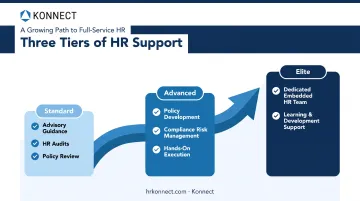
Konnect's tiered model reflects the range of what businesses actually need:
- Standard: advisory guidance, HR audits, and policy review, with your team handling execution
- Advanced: adds policy development, compliance risk management, and hands-on HR execution
- Elite: a dedicated, embedded HR team plus learning and development support
Pricing scales with headcount, starting around $499 per month for businesses with 1-4 employees and rising to roughly $5,999 per month for organizations above 250 employees, plus a one-time audit and setup fee. Each tier includes access to an HR professional, self-service tools, and ongoing support by phone, chat, or email.
Before choosing a path, weigh three factors:
- Headcount: how close are you to the 15, 20, or 50-employee thresholds that trigger new federal obligations?
- Industry risk exposure: healthcare, hospitality, and retail all carry higher compliance scrutiny than lower-risk office environments.
- Multi-state footprint: remote hires across state lines multiply the number of wage, leave, and posting rules you must track.
DIY tools work fine for a five-person team in one state. A PEO helps with payroll and benefits at scale. Dedicated HR consulting earns its cost the moment your risk profile outgrows a generic template.
Frequently Asked Questions
What is the most common HR complaint?
Retaliation has topped EEOC charge categories in recent years. Harassment, discrimination, unfair treatment, and pay disputes are also among the most frequently reported HR complaints.
At what company size do you need HR?
Formal HR support is often recommended around 10-15 employees, since several federal obligations, including Title VII and the ADA, attach at 15. That said, some duties, like the Equal Pay Act, apply from your very first hire.
What is the best HR system for small business?
There's no single "best" system. Most small businesses pair payroll or HR software for daily tasks with outsourced expert guidance for the compliance-heavy decisions software can't make on its own.
What happens if a small business is not HR compliant?
Consequences range from fines and back pay to lawsuits, higher turnover, and reputational damage. Employment claims that reach settlement have averaged roughly $160,000 in combined defense and settlement costs.
Do HR compliance requirements change every year?
Yes. Minimum wage, paid leave, and reporting rules are updated frequently at the state and local level, so review your compliance checklist at least twice a year.
Can a small business handle HR compliance without a dedicated HR department?
Yes. Many businesses manage compliance through a mix of software, checklists, and periodic expert consultations rather than a full-time HR hire, scaling up support as headcount grows.