Introduction
Rising compliance demands, a persistent talent shortage, and tighter budgets have pushed HR outsourcing from a niche tactic to a mainstream business strategy.
In May 2026, 29% of small businesses reported job openings they couldn't fill, and nearly half of those hiring said they found few or no qualified applicants, according to NFIB's May 2026 Jobs Report.
Cost savings gets most of the credit for why companies outsource HR, but the real payoff usually shows up elsewhere: stronger retention and fewer legal headaches, plus a healthier day-to-day culture.
This article breaks down 10 concrete benefits of outsourcing HR, the signs that suggest you're ready, and what to look for in a partner.
Key Takeaways
- HR outsourcing lowers costs while delivering specialized expertise most businesses can't hire in-house
- The biggest impact often lands in culture, engagement, and retention, not just paperwork
- PEOs, HROs, and boutique HR firms offer very different levels of control and service
- Look for partners with executive-level HR experience, not just administrative support
What Is HR Outsourcing?
HR outsourcing means hiring a third-party firm to manage some or all of your HR functions instead of building an entire department internally. It's not one-size-fits-all.
The spectrum runs wide:
- Single-function support: outsourcing one task, like payroll or recruiting
- Embedded HR partnerships: a firm works alongside your team, handling strategy and execution across multiple disciplines
- Full-service PEOs: the provider takes on co-employment status, becoming a joint employer for tax and benefits purposes
- HR Centers of Excellence: specialists assigned to specific disciplines (compensation, compliance, culture) rather than one generalist covering everything
The distinction matters. A PEO shifts legal employer responsibilities to the provider, while a non-co-employment model, like an embedded HR consultancy, lets you keep full control of your workforce while still gaining outside expertise.
Either way, the real value goes beyond cutting costs: you gain access to specialized knowledge and shed the administrative weight that's slowing your business down.
10 Benefits of Outsourcing HR
These benefits span four areas businesses track most closely when evaluating HR performance: cost, compliance, talent, and culture. Here's how each one plays out in practice.
Benefit 1: Cost Savings
Building an in-house HR function isn't cheap. The median annual wage for an HR specialist is $72,910, and for an HR manager it climbs to $140,030, according to BLS Occupational Outlook data for May 2024. That's before benefits, software, or training.
Outsourcing shifts this to a scalable fee. Konnect's retainer model, for example, ranges from $499/month for businesses with 1–4 employees to $5,999/month for organizations with 250+ employees, a fraction of one full-time HR salary that comes with access to a broader team of specialists instead of a single generalist.
Benefit 2: Access to Specialized HR Expertise
Most internal HR teams cover the basics well but lack deep bench strength in compensation design, employee relations, or multi-state compliance. Outsourcing partners bring cross-industry knowledge built from working across dozens of companies, not one.
Firms led by former CHROs or VPs of HR bring a different caliber of insight entirely. Konnect's founder, Jamie Viramontes, held CHRO roles at Forever 21 and UCI Health and served as VP of HR at Chipotle, bringing strategic-level experience rarely available to small or midsize businesses without an outsourcing arrangement.
Benefit 3: Reduced Compliance Risk
Labor law changes constantly, and multistate employers face a moving target. The Department of Labor's 2026 maximum penalty for a repeated or willful FLSA minimum-wage or overtime violation sits at $2,515 per violation, and the EEOC recovered $660 million for 17,680 victims in FY2025 alone.
Outsourcing providers track these shifts full-time, something most internal teams can't dedicate resources to. This typically includes:
- Ongoing monitoring of federal, state, and local employment law changes
- Policy and handbook audits to close compliance gaps before they become violations
- Multi-state regulatory frameworks for companies operating across jurisdictions
- Compliance training on anti-harassment, health and safety, and data protection

Benefit 4: Time Savings for Leadership
Founders and managers routinely lose disproportionate hours each week to HR admin: onboarding paperwork, benefits questions, and policy enforcement. None of that time goes toward revenue-generating work.
Consider a 15-person business where the owner personally handles every new hire's paperwork, fields benefits questions, and drafts policies from scratch. That's easily 8-10 hours a week gone. Delegating these tasks to an outsourced partner frees leadership to focus on growth, sales, or product, while the administrative load moves elsewhere.
Benefit 5: Access to Competitive Employee Benefits
Small businesses often struggle to offer benefits packages that compete with larger employers. BLS data shows medical-plan access at only 59% of workers in establishments with 1-99 employees, compared to 87% at companies with 100+ employees.
Outsourcing partners can help close this gap through:
- Benefits administration support that lightens internal workload
- Guidance on structuring competitive Total Rewards packages
- Coordination across compensation and benefits strategy
This levels the playing field for smaller companies competing for the same talent pool as larger employers.
Benefit 6: Stronger Recruitment and Talent Acquisition
Hiring is expensive and slow when handled without dedicated expertise. SHRM's 2026 benchmarking data puts the median cost per hire at $1,300 for nonexecutive roles and $15,000 for executive roles, with time-to-fill averaging 39 and 45 days respectively.
Outsourced recruiting support typically covers:
- Job postings and candidate screening
- Structured interview processes and interview training for hiring managers
- Background checks and credential verification
- Executive search for senior leadership roles
Better hiring processes reduce the odds of a bad hire, which carries its own steep cost in lost productivity and rehiring expenses.
Benefit 7: Improved Employee Engagement and Culture
This is where the gap between administrative outsourcing and true HR leadership becomes obvious. Anyone can process paperwork. Building a culture people want to stay in takes real expertise.
Experienced HR partners design:
- Pulse surveys for real-time feedback loops
- Formal engagement surveys to diagnose organizational health
- Employee Resource Groups and belonging initiatives
- Internal communication strategies that reinforce company values
Leadership that's built cultures of engagement before (not just managed spreadsheets) tends to design programs that actually move morale, not just check a box.
Benefit 8: Increased Retention Rates
Turnover is expensive, and the cost varies sharply by role. Gallup estimates replacement costs at roughly 40% of salary for frontline employees, 80% for technical professionals, and 200% for managers and leaders. Notably, 42% of employees who voluntarily left said their manager or organization could have prevented it.
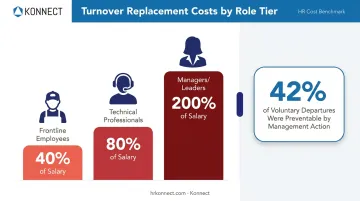
Better onboarding, transparent benefits, and consistent engagement programs directly address that preventable share. Retention-focused HR leadership pays for itself quickly: the fix often costs far less than the turnover it prevents.
Benefit 9: Scalability as the Business Grows
Headcount rarely grows in a straight line. A company hiring rapidly during expansion needs different HR support than one navigating a slow quarter, and building or cutting internal HR staff to match is disruptive and costly.
Outsourced models flex instead of break. A business moving from 15 to 60 employees, for example, might shift from a fractional HR manager model to a dedicated HR Business Partner without ever hiring or laying off internal HR staff. The service level simply adjusts as the org chart does.
Benefit 10: Access to Better HR Technology
Standalone HR software isn't cheap either. Per-user pricing tiers for HR platforms run from $65/month at the entry level up to $650/month for high-end plans, according to Software Advice's 2026 pricing guide — and that's before implementation and training costs.
Outsourcing partners often include platform access as part of the service:
- Self-service portals for employee questions and document requests
- Learning management systems for compliance and skills training
- AI-powered tools that reduce administrative back-and-forth
- Centralized policy libraries and handbook management
Businesses gain the technology stack without the upfront software investment or the internal team needed to manage it.
Signs Your Business May Need to Outsource HR
Certain patterns tend to show up consistently before a business decides to bring in outside HR help:
- HR tasks consuming disproportionate time from founders, managers, or whoever handles them informally
- Compliance gaps or past legal issues piling up, even minor ones
- Company growth outpacing informal people management, with no dedicated HR staff in place
- HR responsibilities scattered across finance, operations, or office management, with no clear owner
Businesses without dedicated in-house HR leadership are especially exposed to inconsistent policies and reactive, rather than strategic, people management. And delaying the decision rarely helps. The costs and turnover that stem from HR gaps tend to compound the longer they go unaddressed.
How to Choose the Right HR Outsourcing Partner
Not all outsourcing providers offer the same depth. Some deliver transactional, administrative support. Others bring strategic, executive-level guidance that shapes how your business operates.
When evaluating potential partners, look for:
- Industry-specific expertise: a firm that understands the regulatory and workforce dynamics of your sector, whether that's healthcare, retail, hospitality, or nonprofit
- Scalability: a service model that grows with your headcount instead of forcing you to switch providers
- Communication and service model: clarity on who you'll work with and how quickly you can reach them
- Proven experience: a track record with businesses similar in size and complexity to yours
The strongest partners combine hands-on leadership experience with a scalable service model, rather than generic HR support applied uniformly to every client.
Konnect, for instance, is built around a Center of Excellence model. The company was founded by Jamie Viramontes, an HR executive with more than 25 years of experience across companies including Forever 21, Chipotle, and UCI Health.
Rather than assigning one generalist to every need, the model routes clients to specialists: a compensation review goes to a compensation analyst, not a general HR manager. That structure spans industries including food & beverage, healthcare, retail, and tech.

Before signing with any provider, ask directly about their leadership team's real-world HR experience. A service menu tells you what they offer. A leadership bio tells you whether they can actually deliver it.
Conclusion
HR outsourcing's real value goes well past the monthly invoice. Done right, it touches:
- Compliance and risk management
- Employee retention and engagement
- Company culture
- Your organization's ability to scale
These benefits compound over time, especially when paired with a partner that brings genuine HR leadership experience rather than administrative processing alone. If HR pain points are already draining your leadership team's time or exposing you to risk, a scalable, expert-led partner like Konnect can remove that barrier.
Frequently Asked Questions
Is outsourcing HR a good idea?
Yes, for most small and midsize businesses lacking in-house HR expertise. The actual value depends on choosing a partner with the right experience level and service model for your needs.
What is the difference between a PEO and HR outsourcing (HRO)?
A PEO operates under co-employment, becoming a joint employer responsible for tax and benefits administration. An HRO or HR consulting firm provides advisory and operational support while your business remains the sole employer of record.
How much does it cost to outsource HR?
Costs vary based on business size and scope of services, typically running in the hundreds to low thousands per month rather than the six-figure cost of a full in-house HR team. Setup or audit fees may apply upfront.
What HR functions can be outsourced?
Common functions include compliance management, recruiting, benefits program guidance, performance management, employee relations, and learning and development. Scope varies by provider and service tier.
Will outsourcing HR mean losing control over my employees?
No. In a non-co-employment model, your business retains full control over daily management, hiring decisions, and workforce direction. The outsourcing partner handles administrative and compliance execution alongside you.
What size business should consider outsourcing HR?
Both ends of the spectrum benefit — small businesses without any HR staff and larger enterprises seeking specialized expertise they can't justify hiring full-time for every discipline.