Introduction
Most founders assume their startup will die from running out of cash or building the wrong product. Often, the real cause is people.
Research from Harvard Business Review found that founder and team conflict contributes to 65% of startup failures, not product-market fit or funding gaps.
Here's the founder's dilemma: you're recruiting, managing performance reviews, writing offer letters, and trying to stay compliant across state lines, while building and shipping a product. Something gives, and it's usually HR.
This guide breaks down the unique HR challenges startups face, the core consulting services worth paying for, what they cost, and how to pick a partner who understands early-stage companies. The right HR support protects your team and keeps growth on track.
Key Takeaways
- Startup HR risk differs from enterprise risk: speed, funding cycles, and tiny teams change the rules
- Consulting delivers executive-level HR expertise (recruiting, compliance, culture, performance) without a full-time salary
- Fractional retainers, project fees, and outsourced bundles scale HR support with company size
- Early HR investment strengthens compliance, retention, and investor confidence during fundraising
Why Startups Need HR Consulting: The Unique Challenges of Early-Stage Growth
Startups don't operate like corporations, and their HR shouldn't either. Early-stage companies run on agility, not hierarchy. Hiring often happens in sudden bursts tied to a funding round, and the same person handling sales might also be doing onboarding paperwork.
That's a different "HR DNA" than a company with an established org chart, and it creates specific risks.
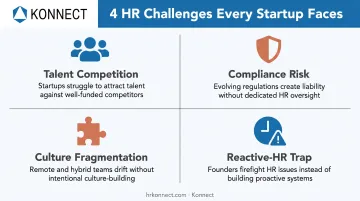
The Talent Competition Problem
Startups are fighting for the same candidates as companies with bigger budgets and recognizable brand names. SHRM's 2025 research found that 69% of organizations reported difficulty recruiting for full-time positions, citing too few applicants and stiff competition from other employers.
Without a structured recruiting process, lean teams lose good candidates to slow decision-making and weak job descriptions. Many also lack an employer brand candidates can evaluate.
Compliance Risk Nobody's Watching
Startups can misclassify workers, miss overtime rules, skip required notices, or violate state-specific labor laws without realizing it—especially once hiring crosses state lines. The Department of Labor's economic-realities test makes clear that a 1099 agreement or job title alone doesn't determine whether someone is legally a contractor or an employee.
Headcount thresholds matter too:
- 15+ employees — Title VII and ADA protections apply
- 20+ employees — Age Discrimination in Employment Act applies
- Multi-state hiring — each state can have different minimum wage and leave rules
Culture Fragmentation as You Scale
Early culture often mirrors the founder's personality. It works great at five people. At 30, it starts to break unless someone is deliberately maintaining it. Glassdoor and Harris Poll research found that 77% of adults would consider a company's culture before applying, and 73% wouldn't apply unless a company's values matched their own.
The Reactive-HR Trap
Many founders only think about HR after something goes wrong: a compliance fine, unexpected turnover, or a messy termination. By then, the fix costs far more than prevention would have.
Even a 5-10 person team benefits from basic structure: written policies, a real onboarding process, documented expectations, and a clear path for handling issues early. "HR can wait" is a myth that gets expensive fast.
Key HR Consulting Services for Startups
Good HR consultants don't offer generic advice. They work across defined service areas with real specialists.
Konnect, for example, uses a "Center of Excellence" model staffed by former CHROs and VPs of HR from companies like Forever 21, Chipotle, and UCI Health. Startups get executive-level input on demand instead of one generalist covering everything.
Recruitment and Talent Acquisition
Consultants help define roles clearly, build structured interview processes, and develop employer branding that lets a five-person team compete with a 500-person company for the same candidate. Typical deliverables include:
- Executive recruiting for senior hires
- Recruitment research and talent mapping
- Background checks and credential verification
- Interview training for hiring managers
- EVP development with social and video content that shows culture authentically
HR Policy Development and Compliance
As headcount grows, so does legal exposure. Consultants draft policies that keep pace with requirements triggered at specific headcount thresholds. Typical documents include:
- Employee handbooks
- Offer letters and separation agreements
- Leave and time-off policies
Konnect's Employer Resource Center gives clients ongoing access to compliance documents and alerts on federal and state employment-law changes, so policies don't quietly go stale.
Performance Management and Culture Building
Rigid annual reviews don't fit a 15-person team. Consultants design lightweight feedback systems built around quarterly check-ins, coaching frameworks, and Individual Development Plans. The point is reinforcing culture, not checking a compliance box.
Compensation Design and HR Technology
Consultants help structure pay and equity packages that stay competitive without blowing the budget. They also guide startups toward practical HR tools—payroll, applicant tracking, and onboarding platforms—so the stack fits the stage you're in.
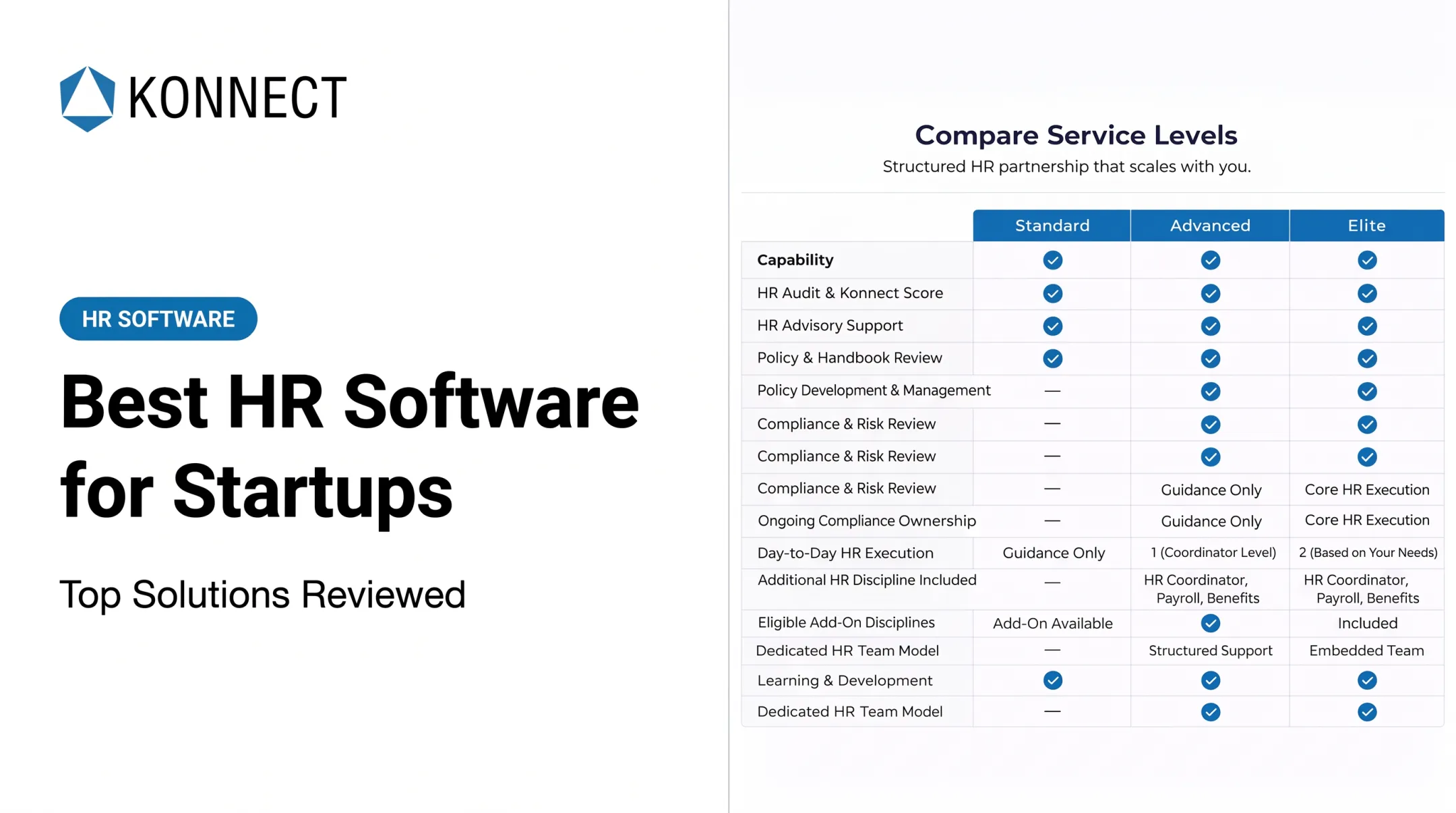
Getting this right early avoids expensive replatforming later. Konnect's KonnectAi platform, for example, automates routine HR tasks and integrates with Slack and Microsoft Teams, so a small team can answer HR questions without adding headcount.

Benefits and Costs of HR Consulting for Startups
Key Benefits of Partnering with an HR Consultant
The core value is access. You get senior HR expertise on a flexible basis instead of paying for a full-time executive you can't yet afford. That translates into:
- Reduced compliance exposure through documented, audit-ready policies
- Stronger retention via structured onboarding and feedback loops
- Faster hiring through defined interview processes and employer branding
Investor confidence is another practical payoff. Series A due diligence routinely requests employee lists, classification records, compensation details, and the employee handbook.
Clean HR documentation won't guarantee a term sheet, but messy records can slow one down.
How Much Does HR Consulting Cost for Startups?
Startups generally encounter three pricing models:
- Hourly or project-based — good for a one-time need, like a handbook audit
- Fractional monthly retainer — ongoing access to HR expertise at a fraction of a full-time salary
- Outsourced bundled services — broader HR support packaged into one monthly fee
Pricing typically scales with headcount and scope. Konnect's monthly retainers, for example, run:
| Company Size | Monthly Retainer | One-Time Setup Fee |
|---|---|---|
| 1-4 employees | $499 | $500 |
| 5-19 employees | $899 | $500 |
| 20-49 employees | $1,299 | $1,000 |
| 50-99 employees | $2,500 | $1,500 |
| 100-249 employees | $4,999 | $3,000 |
| 250+ employees | $5,999 | $3,500 |
The setup fee covers an initial HR audit and policy review. The monthly retainer covers ongoing access to an HR professional, guidance, and support channels.
Other factors that affect pricing include industry compliance complexity (healthcare and finance typically cost more than general retail) and whether the engagement is one-time or ongoing.
Consulting is still usually cheaper than a full-time HR hire, since you pay only for the expertise and hours you actually need.
How to Choose the Right HR Consulting Partner for Your Startup
Not every HR consultant understands startups. Enterprise HR experience doesn't automatically translate to a 12-person company burning through runway. Look for these signals:
- Direct early-stage experience — Ask specifically about work with companies your size, not just HR experience in general
- Flexible, scalable models — Start with one project, like an employee handbook, and grow into ongoing support without a full re-contract
- Industry-specific expertise — Compliance and talent needs differ sharply between tech, healthcare, food & beverage, and retail
- Executive HR leadership on staff — Firms led by people who've held CHRO or VP of HR titles bring pattern recognition generalist consultants often lack
- References or concrete case examples — Ask how they've helped similarly sized companies solve real problems: turnover spikes, compliance gaps, scaling hires

Konnect is built around that executive-leadership standard. Founder Jamie Viramontes is a former CHRO with more than 25 years of HR leadership at Forever 21, Chipotle, and UCI Health.
That background shapes staffing: a compensation review goes to a compensation analyst, not a generalist HR manager. Clients like YETI and ASICS have used that specialist model for retail expansion and global people-experience work while keeping culture intact.
Frequently Asked Questions
How much does HR consulting cost?
Pricing depends on the model: project-based, fractional retainer, or outsourced bundle. For startups, monthly retainers often start around $500 for very small teams and scale into the thousands with headcount and scope, sometimes plus a one-time setup or audit fee.
What is the best HR platform for startups?
There isn't one best platform for every startup. It depends on team size and what you need most right now. HR consultants help evaluate payroll, ATS, and onboarding tools that fit your current headcount and growth plans.
Do startups really need HR consulting if the team is small?
Yes. Even a 5-10 person team benefits from basic policies, structured onboarding, and compliance checks. These prevent disputes later and build a foundation that scales as headcount grows.
When should a startup hire an HR consultant?
Common trigger points include rapid hiring, your first hire outside your home state or country, compliance concerns, unexpected turnover, or preparing for a funding round. Waiting until a crisis hits usually costs more than acting early.
Can HR consulting help with fundraising or investor readiness?
Yes. Consultants help document policies, compliance status, and workforce metrics investors typically request in due diligence, especially around Series A.
Is HR consulting the same as outsourcing HR entirely?
Not necessarily. Consulting ranges from project-based advice, like a handbook review, to fully embedded HR execution, depending on what your startup needs at that stage.