Recruiting, payroll, employee support — AI touches all of it now. But HR leaders feel the tension. Move too fast and you risk turning people operations into a chatbot maze. Move too slow and you fall behind competitors already saving hours a week on admin work.
This article breaks down what AI and automation actually mean in HR, where they're already being used, the real benefits and risks, and how to build a strategy that keeps HR human while still moving fast.
Key Takeaways
- AI adoption in HR nearly doubled year-over-year, but most leaders still lack a cohesive strategy
- Automation handles repetitive tasks; AI adds judgment, prediction, and generated content
- Recruiting automation has cut time-to-fill by half in documented cases
- Sensitive matters — terminations, disputes, performance issues — still need human judgment
- A clear automate/augment/human-led framework prevents tool overwhelm
What Is AI and Automation in HR?
People use "AI" and "automation" interchangeably, but they're not the same thing. Automation follows fixed rules. AI learns, predicts, and generates. In practice, most HR tech today blends both: automation handles the repetitive plumbing, while AI adds the judgment layer on top.
Automation in HR
Automation is software executing repetitive, high-volume, rules-based work without a human touching it. Think leave request approvals, onboarding paperwork routing, or shift scheduling.
Despite years of HR tech investment, most teams still drown in transactional work. Administrative tasks still consume most of the workweek for many HR teams, leaving far less time for strategic planning. That imbalance is exactly what automation is designed to fix.
AI in HR
AI in HR means machine learning, natural language processing, and generative AI supporting decisions, personalizing experiences, and simulating human interaction. This includes:
- Chatbots and AI agent tools that field employee questions in real time
- Predictive analytics flagging flight risk or hiring bottlenecks
- Generative AI drafting job descriptions, policies, or feedback summaries
The two are converging fast. Agentic AI now handles multi-step workflows end-to-end rather than isolated tasks.
KonnectAi is one example of that shift: agentic generative AI that answers employee and leader questions about policies and benefits around the clock, tags and prioritizes requests by urgency and tone, and connects with tools such as Microsoft Teams, Slack, Workday, and ADP.
When a question gets complex or personal, it routes the person to an HR expert instead of leaving them stuck in a bot loop.
How AI and Automation Are Transforming the Employee Lifecycle
AI and automation aren't confined to one HR function anymore. They show up at nearly every stage of the employee journey.
Recruitment and Hiring
AI now screens resumes, matches candidates to open roles, schedules interviews automatically, and summarizes feedback so hiring teams decide faster.
The results can be dramatic. Fortitude Re reported cutting its time-to-fill by 50% after adopting AI-supported recruiting tools. One role that previously took more than 100 days to fill was closed in as few as 20.
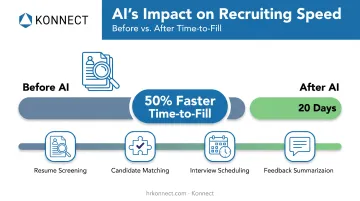
Recruiters still made the final call on leadership, collaboration, and cultural fit. The AI handled sourcing and logistics; humans made the judgment calls.
That balance matters. Konnect's own talent acquisition services (executive search, recruitment research, background checks, interview training) stay human-led by design, because culture fit isn't something an algorithm should decide alone.
Onboarding
AI-driven virtual assistants now guide new hires through paperwork, policy acknowledgments, and orientation steps—without HR walking each person through every form by hand.
KonnectAi lists onboarding as one of its core use cases: new hires get 24/7 access to HR information, automated help with routine documentation, and a direct escalation path to a human expert if something falls outside the standard script.
Employee Engagement, Retention, and Support
Routine questions (PTO balances, benefits eligibility, policy details) used to sit in an HR inbox for days. Now an AI agent answers instantly.
- Instant Q&A for policy and benefits questions, available around the clock
- Request tagging by urgency and tone, so nothing urgent gets buried
- Pulse surveys that track morale trends so HR can spot disengagement before it becomes turnover
Learning, Development, and Performance Management
AI increasingly generates personalized training content, recommends learning paths tied to skill gaps, and helps managers write sharper, more specific feedback instead of vague annual-review language.
Platforms like Konnect's KonnectED LMS, powered by Absorb, support this shift by centralizing assigned learning paths, tracking completion, and issuing certifications. That structure is what AI-driven personalization builds on.
Administrative and Compliance Operations
Multi-state employers face a constantly shifting patchwork of employment law. AI-supported tools help by monitoring regulatory changes and automating reporting, cutting manual admin work and legal exposure.
KonnectER, for instance, delivers ongoing notifications about federal and state employment-law changes and centralizes compliance documents (handbooks, offer letters, separation agreements) in one portal. HR teams stop chasing the latest requirement across five different states.
Benefits of AI and Automation in HR
The upside is straightforward: less time on paperwork, more time on people.
- Frees HR for coaching, conflict resolution, and culture-building by cutting repetitive admin
- Surfaces hiring, retention, and workforce-planning patterns that would take weeks to find manually
- Improves the employee experience with 24/7 self-service, faster responses, and personalized development
The time savings are real. SHRM found that automating administrative tasks saved HR staff more than seven hours per week: nearly a full workday back for coaching, culture, and better decisions.

Challenges and Risks HR Leaders Must Navigate
Adoption isn't risk-free. The same issues surface in most HR rollouts:
- Data privacy and legal exposure. New York City's Local Law 144 requires bias audits and advance notice before employers use automated hiring tools. Colorado's SB24-205 mandates risk-management programs and human review for high-risk AI systems.
- Real enforcement risk. The EEOC has already acted: iTutorGroup paid $365,000 to settle charges that its recruiting software automatically rejected applicants over a certain age. A written AI usage policy isn't optional anymore.
- The skills gap. Plenty of HR professionals haven't been trained to use AI tools well, let alone interpret outputs critically.
- Tool overwhelm. Teams adopt scattered point solutions (a chatbot here, a survey tool there) without a cohesive plan, leaving expensive tools underused.
- Change management. New systems fail without real communication, training, and buy-in from HR staff and employees. Rolling out a tool nobody understands is worse than skipping it.
- Over-automating sensitive matters. Terminations, harassment complaints, and performance disputes need human judgment and empathy. No algorithm should make that call alone.
Building an AI Strategy That Keeps HR Human
Random tool adoption is how "tool overwhelm" happens. A real strategy starts with sorting tasks into three buckets:
- Automate — repetitive, rules-based tasks with no judgment required
- Augment — tasks where AI speeds up a human decision rather than replacing it
- Keep human — anything involving empathy, ethics, or high-stakes judgment
Strong governance matters just as much as the technology itself. AI should reinforce company culture and compliance, not undermine either.
This is where experienced HR leadership earns its keep. Konnect built its Center of Excellence model around this problem: specialized expertise across Talent, HR Operations, Development, Culture, General HR, and Total Rewards.
The team includes people who've held CHRO and VP-level roles at companies like Forever 21 and Chipotle. Rather than a generalist guessing at what to automate, you get someone who's run these functions at scale and can help choose tools that fit your culture, compliance needs, and growth stage.
Two more practical notes:
- Start small. Pilot AI on one high-volume, low-risk process before rolling it out across the entire employee lifecycle.
- Upskill your team. HR staff need enough AI and data literacy to question outputs, not just accept them. They become the translator between the technology and the people it affects.
The Future of AI and Automation in HR
More organizations are becoming "AI-first," where HR manages hybrid teams in which a human employee and an AI agent work side by side. Onboarding and support tickets already run this way at many companies.
HR's role is shifting accordingly. HR professionals need to be both tech interpreters and people advocates, so AI adoption tracks with company values instead of chasing efficiency for its own sake.
Treat AI maturity as an ongoing journey, not a single rollout you finish and forget:
- Automate routine workflows first
- Augment human judgment with AI insights next
- Amplify strategic HR impact once the foundation is solid

Frequently Asked Questions
How will AI be used in HR?
AI supports recruiting, onboarding, engagement, learning, and performance management by automating routine tasks and surfacing data-driven insights. HR teams still make the judgment calls.
What is automation in HR?
Automation uses software to handle repetitive, rules-based HR tasks — payroll processing, leave requests, onboarding paperwork — without manual effort at each step.
Will AI replace HR jobs?
No. Tasks that require empathy, ethical judgment, and complex problem-solving remain human, and no tool has closed that gap.
What are the biggest risks of using AI in HR?
Data privacy, algorithmic bias, skills gaps among HR staff, and over-reliance on automation for sensitive employee matters top the list.
How can small businesses start using AI in HR?
Start with one high-volume process, like routine employee questions or scheduling. Partnering with HR experts helps build a strategy sized to your actual needs, not a generic template.
Do I need a dedicated AI strategy for HR?
Yes. Without one, tool adoption gets fragmented fast. A clear strategy keeps AI investments aligned with business goals, compliance requirements, and company culture.