Introduction
A new state privacy law. An updated overtime rule. A surprise OSHA inspection. For many business owners, keeping up with regulatory change feels like a full-time job on top of the one they already have.
The stakes are real. In fiscal year 2025 alone, the Department of Labor recovered more than $259 million in back wages for 176,957 workers.
That same year, the EEOC secured nearly $660 million in monetary relief for workers. Those numbers reflect enforcement activity, not average business losses, but they show regulators are active and penalties are far from theoretical.
This is where compliance solutions come in. A compliance solution is the system of policies, processes, and expert guidance businesses use to meet legal and regulatory obligations before they become expensive problems. This article breaks down what compliance solutions actually include and the four types every business should understand. It also covers the five principles behind effective programs and how to choose a partner that fits your size and industry.
Key Takeaways
- Compliance solutions combine policies, processes, and expert support to meet legal and internal standards
- Four categories define compliance scope: regulatory, financial, data/security, and employment/HR
- Strong programs share five principles: accountability, policies, training, monitoring, and corrective action
- Partnering with an experienced HR provider like Konnect reduces risk while strengthening culture and retention
What Is a Compliance Solution?
A compliance solution is the combination of tools, processes, policies, and expert guidance an organization uses to meet its legal, regulatory, and ethical obligations. It's not a single product. It can look like:
- Software platforms that track deadlines and documentation
- Consulting services that review policies and flag risk
- Fully outsourced HR and compliance management
Reactive vs. proactive compliance is the key distinction. Reactive compliance responds after a violation, audit, or complaint has already surfaced. Proactive compliance builds the systems, training, and monitoring that catch problems before regulators or employees do. The second approach costs less in the long run, even though it requires upfront investment.
The Cost of Getting It Wrong
SMB-specific cost data is limited, but the enforcement numbers cited earlier tell a clear story. Agencies are actively recovering back pay, damages, and penalties from employers who fall short on wage, safety, or classification standards. A single misclassification finding, for instance, can trigger back-pay claims across an entire employee class rather than one individual.
The initial fine rarely reflects the full cost. Add in:
- Legal fees to respond to an audit or claim
- Reputational damage that affects hiring and retention
- Lost productivity while leadership manages the investigation
Together, these expenses often dwarf the original penalty.
Compliance Scales With Business Size
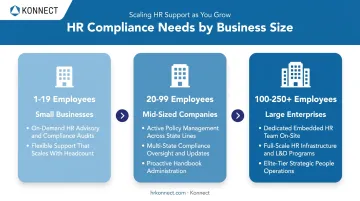
A five-person startup and a 300-employee enterprise face very different compliance realities:
- Small businesses typically need scalable, outsourced support since they lack the headcount to justify a dedicated compliance officer
- Mid-sized companies often need active policy management and ongoing risk oversight as they add employees across multiple states
- Large enterprises generally require dedicated compliance infrastructure, often with embedded HR teams managing multiple disciplines at once
This is where HR-specific compliance solutions come in. Konnect's Center of Excellence model, for example, addresses people-related risk areas like wage and hour compliance, employee classification, and workplace safety — the areas where most employment claims originate.
The 4 Types of Compliance Every Business Should Know
Compliance isn't one thing. It's typically grouped into four categories, each covering a different business risk area.
Regulatory Compliance
Regulatory compliance addresses adherence to government and industry regulations, including OSHA workplace safety standards and EEOC anti-discrimination requirements. Coverage thresholds matter here: EEOC laws generally apply to employers with 15 or more employees (20 or more under the ADEA), so smaller businesses aren't automatically exempt from every rule.
Financial Compliance
This involves meeting financial reporting standards, tax obligations, and regulations like the Sarbanes-Oxley Act (SOX) for public companies and other reporting issuers. Smaller, non-accelerated filers often qualify for exemptions from certain audit requirements, but the underlying reporting duties still apply.
Data and Security Compliance
Data and security compliance protects sensitive data under frameworks like HIPAA (for covered health plans), GDPR (for companies serving EU residents), or state privacy laws like the CCPA. Threshold requirements vary widely, so businesses need to know exactly which frameworks apply to their operations.
Employment and HR Compliance
Employment and HR compliance addresses labor laws, wage and hour rules, anti-discrimination policies, and workplace safety. It's the category with the broadest day-to-day impact on most businesses, and it's where Konnect's HR expertise directly supports clients — through policy development, classification guidance, and ongoing regulatory monitoring via tools like KonnectER.
The 5 Core Principles of an Effective Compliance Program
Regardless of industry, strong compliance programs share five foundational principles. These align closely with the frameworks federal regulators use when evaluating whether a company's compliance efforts were genuine or superficial.
Here's what each principle looks like in practice:
- Leadership and Accountability: Compliance has to be championed from the top. A compliance officer, HR leader, or executive sponsor needs clear ownership, authority, and direct access to leadership.
- Written Policies and Procedures: Documented, accessible policies remove ambiguity. Employees and managers can't follow rules they've never seen written down.
- Training and Communication: Ongoing training ensures policies are understood and applied consistently, not just filed away after onboarding. A learning management system, like Konnect's KonnectED platform, powered by Absorb, keeps training current and trackable.
- Monitoring and Auditing: Regular audits catch gaps before they escalate into violations. Konnect's own audit process produces a Konnect Score, grading HR maturity across eight categories a real labor audit would examine, including wage and hour compliance and anti-harassment policies.
- Prompt Response and Corrective Action: A clear process for addressing violations quickly shows good faith and limits liability. Waiting to see if a problem resolves itself rarely works in a business's favor.

Why Compliance Solutions Matter for Modern Businesses
Non-compliance carries three consequences: financial penalties, legal exposure, and lasting reputational damage. The FLSA, for instance, allows employees to recover back wages plus an equal amount in liquidated damages — meaning a wage violation can effectively double in cost before it even reaches court.
But compliance isn't only about avoiding penalties. Strong compliance practices build employee trust. When policies are clear, applied fairly, and backed by real training, workplace culture improves and retention follows. Konnect founder Jamie Viramontes saw this pattern firsthand in CHRO and VP roles at Forever 21, UCI Health, and Chipotle, where clear policies consistently translated into stronger engagement and retention.
Compliance has also gotten harder to manage internally:
- Remote work has expanded multi-state exposure. As of 2023, 13.8% of U.S. workers usually worked from home, more than double the 5.7% rate in 2019
- Each remote employee can trigger a new state's withholding, unemployment, and labor law requirements
- Multi-state operations mean tracking dozens of overlapping regulatory calendars at once
This complexity is exactly why expert guidance has become more valuable, not less. Tools like KonnectER exist specifically to centralize compliance policy libraries and handbook management, so businesses aren't caught off-guard by a rule change in a state they barely realized they had employees in.
How to Choose the Right Compliance Partner
Not all compliance partners offer the same depth of support. Businesses should look for:
- Industry-specific expertise: A healthcare practice and a retail chain face very different regulatory pressures, so a generic template won't cover either well.
- Scalability that supports a five-person team today and a 250-person team down the road, without a jarring transition.
- A proven compliance track record: specialists who have personally managed audits and investigations, beyond software-driven checklists.

The strongest partners combine executive-level experience with hands-on implementation. A policy template only helps if someone knows how to apply it to your specific workforce and industry.
Konnect's Center of Excellence model reflects this approach. Founder Jamie Viramontes brings more than 25 years of HR leadership, including CHRO roles at Forever 21 and UCI Health, VP of HR at Chipotle, and experience at JPMorgan Chase.
That background spans retail, healthcare, food service, and finance, covering four of the most heavily regulated employment environments in the country.
Konnect's tiered pricing reflects this scalability directly:
| Employee Count | Monthly Retainer | Compliance Support Level |
|---|---|---|
| 1–19 employees | $499–$899/mo | Standard: audit, policy review, risk assessment |
| 20–99 employees | $1,299–$2,500/mo | Advanced: active policy development, ongoing risk management |
| 100–250+ employees | $4,999–$5,999/mo | Elite: full compliance ownership, embedded HR team |
Every tier starts with the Konnect Audit and Konnect Score, giving businesses a measurable compliance baseline from day one, regardless of size.
Frequently Asked Questions
What is a compliance solution?
A compliance solution is the combination of policies, processes, tools, and expert guidance a business uses to meet legal, regulatory, and internal standards. It can range from software to full outsourced HR support.
What are the 4 types of compliance?
The four main types are regulatory, financial, data/security, and employment/HR compliance. Each addresses a different area of legal and operational risk.
What are the 5 principles of compliance?
They are leadership accountability, written policies, training and communication, monitoring and auditing, and prompt corrective action. Together they form the backbone of any credible compliance program.
Who is responsible for compliance in an organization?
Leadership sets the tone, but compliance is a shared responsibility. HR, legal, or a dedicated compliance officer typically coordinates it, while department managers enforce policies day to day.
How much does outsourcing compliance typically cost?
Costs vary by business size and scope. For small-to-mid-sized businesses, outsourced HR compliance support (like Konnect's tiered retainers starting at $499/month) is often more cost-effective than hiring in-house compliance staff.
What happens if a business fails to comply with regulations?
Consequences can include fines, back wages, liquidated damages, lawsuits, and reputational damage. Depending on the violation, a business may also face citations or lose specific licenses or certifications tied to its industry.