That's why businesses of every size, from five-person startups to enterprises with hundreds of employees, are turning to outsourced HR and payroll expertise. This article breaks down what outsourcing actually means, what it costs, which functions make sense to hand off, and how to pick a partner who won't leave you exposed.
Key Takeaways
- Outsourcing moves payroll compliance and admin burden to specialists who own accuracy and deadlines
- Pricing ranges from $1.50 to $12 per employee per month plus base fees, depending on scope
- Keep strategic and culture-building HR work in-house
- Choose providers that pair executive HR experience with scalable service tiers
What Is HR and Payroll Outsourcing?
Payroll outsourcing and HR outsourcing overlap, but they're not identical.
Payroll outsourcing, per IRS Publication 15, means assigning federal tax duties to a third-party payer: withholding, reporting, and paying Social Security, Medicare, FUTA, and income taxes.
Here's the catch: outsourcing payroll doesn't erase your liability. If the third party drops the ball, you can still owe the taxes, penalties, and interest.
HR outsourcing is broader. It covers the people side of the business: recruiting, compliance, employee relations, and benefits coordination.
Some providers operate as PEOs (Professional Employer Organizations), which enter a co-employment arrangement and handle payroll administration and tax reporting on your behalf. Others, like Konnect, operate as full-service HR consulting firms without a payroll-processing or co-employment structure.
Typical outsourced tasks include:
- Wage calculations and payroll tax filing
- Benefits administration and coordination
- Compliance monitoring across states
- HR audits and policy/handbook development
- Recruiting support and onboarding
You don't have to outsource everything. Most businesses pick and choose based on size, risk tolerance, and internal bandwidth.
Key Benefits of Outsourcing HR and Payroll
Time Savings That Compound
Administrative HR work eats more hours than most owners expect. A survey of 289 small-business owners found 45% spent roughly a day per week or more on HR paperwork. For businesses with 20-49 employees, 37% spent 6-10 hours weekly just on HR admin. That's a day and a half of leadership time, gone, before growth work even starts.
Reduced Errors and Compliance Risk
The IRS doesn't go easy on late payroll deposits. Per Publication 15, penalties run:
- 5% for deposits 6-15 days late
- 10% for deposits 16+ days late
- 15% once amounts remain unpaid past the notice deadline Willful noncompliance can trigger the trust-fund recovery penalty, equal to 100% of unpaid trust-fund tax. Expert oversight is a practical hedge against that financial exposure.

Access to Specialized Talent
This is where the Center of Excellence model earns its keep. Instead of routing every request through a generalist HR manager, Konnect matches each need to a specialist:
- Compliance
- Employee relations
- Recruiting
- Learning and development
- Organizational development A compensation review, for example, goes to a Compensation Analyst rather than whoever is available.
Better Employee Experience
Culture isn't fluff. Gallup's Q12 database, covering more than 3.3 million workers, found highly engaged teams see 21% less turnover and 23% higher profitability than bottom-quartile teams. Consistent HR processes and engagement programs feed directly into those numbers.
Data Security Standards
Payroll data is sensitive by nature. NIST's Payroll Profile recommends:
- Classifying PII
- Enforcing least-privilege access
- Requiring multi-factor authentication
- Using out-of-band approval for sensitive changes A qualified provider should already have these controls built into their process.
Scalability
Growth shouldn't mean rebuilding your HR function every time headcount jumps. Konnect's model shifts as clients grow—from a fractional HR Manager for small teams to a Sr. HR Business Partner model at 100+ employees. Clients do not have to renegotiate the relationship from scratch.

What HR and Payroll Functions Can (and Shouldn't) Be Outsourced
Commonly Outsourced Functions
Per SHRM's 2025 CHRO Benchmarking survey of 2,371 members, the most frequently outsourced activities were:
- HR technology (24%)
- Recruiting (22%)
- Learning and development (19%)
- Leadership and manager development (14%)
Payroll processing is still widely treated as the go-to outsourced HR activity. It's transactional, rule-based, and carries steep compliance penalties if handled wrong—so many companies hand it to specialists first.
What Should Stay In-House
Keep these close to home:
- Strategic culture-building
- Leadership decisions
- Sensitive employee-relations matters
They need internal context an outside vendor rarely has, and they shape how your organization runs day to day.
The Hybrid Model
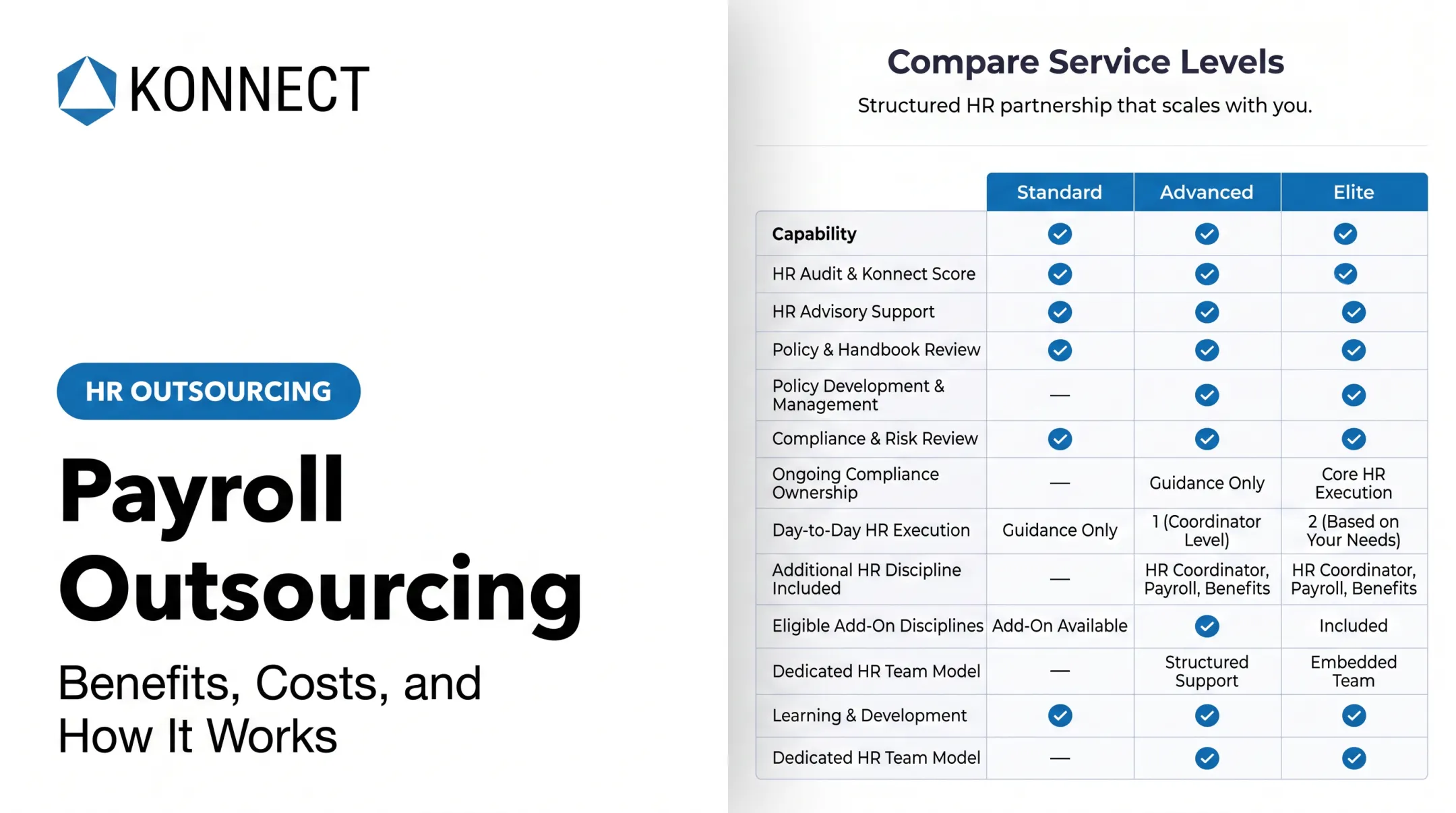
Most companies land somewhere in between. Konnect structures this directly into its tiers:
| Tier | Scope | Best For |
|---|---|---|
| Standard | Advisory, audits, policy review | Companies retaining internal execution |
| Advanced | Core HR execution + one coordinator-level discipline | Growing teams needing hands-on support |
| Elite | Embedded multi-discipline team + L&D | Companies wanting a true extension of leadership |
That mix lets a business hand off transactional HR execution and compliance support while keeping culture and leadership judgment in-house, where they belong.

How Much Does HR and Payroll Outsourcing Cost?
Cost depends on model, headcount, and how much HR work you hand off. Payroll-only outsourcing commonly runs:
- $1.50-$5 per employee per payroll, plus a $20-$70 base fee, according to Complete Payroll Solutions
- $50-$80 base fee plus $6-$12 per employee per month (PEPM), per Sage's 2025 pricing guide—about $2,040-$3,840 a year for a 20-person company
- 3%-12% of total payroll for PEO arrangements, or about $1,395 per employee per year on average per NAPEO research
Full-service HR retainers usually scale by headcount, not a pure payroll percentage. Konnect's monthly HR retainers, for example, run $499/month for 1-4 employees up to $5,999/month for 250+ employees, with one-time setup and audit fees of $500-$3,500 by company size.

Cost matters, but weigh it against what you're avoiding: IRS penalties, turnover costs, and the leadership hours lost to paperwork.
Pros and Cons of Outsourcing HR and Payroll
Pros of Outsourcing
- Efficiency — frees leadership from administrative work
- Compliance support — reduces exposure to IRS and state penalties
- Expertise access — specialists instead of generalists
- Cost predictability — fixed retainers or PEPM pricing simplify budgeting
Cons of Outsourcing
- Less direct control — reduced hands-on say in day-to-day HR decisions
- Quality-cost tradeoffs — cheaper providers may lack depth
- Vendor vetting burden — you still need to verify credentials and track record
Deloitte's 2024 Global Outsourcing Survey of over 500 executives found skilled talent access and agility as top outsourcing drivers, but also noted that governance gaps can limit the payoff.
Founder-led teams with real executive HR experience help close those governance gaps—and the control and vetting risks that come with them. Konnect's CEO brings 25+ years of HR leadership, including CHRO roles at Forever 21 and UCI Health.
YETI's Senior Director, Jayme Barbosa, credited Konnect's "ability to listen and then lead" with freeing her team to focus on retail expansion while keeping engagement strong. Pairing that depth with a scalable structure means fewer surprises and clearer accountability.
Frequently Asked Questions
What is payroll outsourcing?
Payroll outsourcing means delegating wage calculations, tax withholding, and tax filing to a third party. The employer typically remains responsible for ensuring deposits and filings are accurate and timely.
What is the average cost to outsource payroll?
Costs typically range from $1.50-$12 per employee monthly plus a base fee, or 3%-12% of total payroll for PEO models. Exact pricing depends on headcount, frequency, and service scope.
What are the pros and cons of outsourcing payroll?
Pros include fewer calculation errors, stronger tax compliance support, and more predictable monthly costs. Cons include less day-to-day control and the need to carefully vet vendors before you commit.
What HR services can be outsourced?
Commonly outsourced services include payroll processing, benefits administration, recruiting support, onboarding, HR technology, and compliance monitoring.
What HR functions should not be outsourced?
Culture-building, leadership decisions, and sensitive employee relations usually need internal context, so keep those in-house.
What is the most commonly outsourced HR activity?
Payroll processing. It's rule-based and repetitive, and mistakes carry steep tax penalties, so most companies outsource it first.