Introduction
In May 2024, OSHA investigated the death of a 57-year-old worker at Konz Wood Products in Wisconsin, crushed by a lumber-stacking machine while clearing a jam. OSHA alleged the company failed to train employees on machine-safety procedures and proposed $177,453 in penalties across 17 citations.
It's a proposed figure, not a final judgment, but it shows how quickly one training gap can escalate into a federal OSHA investigation.
Most small and mid-sized businesses don't have a dedicated compliance officer or in-house HR expert tracking every federal, state, and industry regulation. That gap leaves real exposure.
This guide covers what compliance training actually involves, why it matters, and the core training types every employer should know. It also walks through how to build a program step by step, including where an outside HR partner fits in.
Key Takeaways
- Compliance requirements vary by state, industry, and headcount—there's no universal rulebook.
- Documented training supports legal defenses but doesn't guarantee immunity from claims.
- Most regulations expect annual refreshers, but HIPAA doesn't mandate yearly retraining.
- Effective programs follow five steps: audit, build content, deliver, track, and review.
What Is Employee Compliance Training?
Compliance training is structured education on the laws, regulations, and internal policies employees need to follow to do their jobs legally and ethically. Rather than a single course, it functions as an ongoing framework that evolves as regulations and business needs change.
Most programs blend two layers:
- External requirements — OSHA safety standards, EEOC harassment guidance, HIPAA privacy rules, and state-specific mandates
- Internal policies — code of conduct, confidentiality agreements, conflict-of-interest rules, and department-specific procedures
The content also shifts by role. A warehouse employee needs hazard-recognition training; a finance manager needs SOX-related disclosure awareness. A one-size-fits-all module rarely covers either group well. Platforms like Konnect's KonnectED LMS handle this by assigning role-specific modules automatically and tracking completion, so training actually matches the job instead of a generic checklist.

Is Compliance Training Legally Required?
Some training is federally mandated, but not universally. OSHA standards attach to specific hazards and industries, not a general course for every employer. HIPAA applies to covered entities and business associates. Title VII and the FLSA don't create one blanket training requirement either.
State and local rules fill the gaps, and they diverge sharply:
| State | Who Must Train | Frequency |
|---|---|---|
| California | Employers with 5+ employees | Every 2 years |
| New York | Every employer | Annually |
| Illinois | Every employer with IL-based staff | Every calendar year |
| Maine | Workplaces with 15+ employees | New hires within 1 year |
Even where training isn't strictly required, documentation still matters. Under the Faragher-Ellerth framework, employers facing certain harassment claims can raise a "reasonable care" defense, and a disseminated policy plus documented training is part of that evidence.
The defense disappears once a tangible employment action occurs, so EEOC guidance treats training as one factor among several, not a shield on its own.
How Often Should Employees Complete Compliance Training?
Annual refreshers are common practice across industries. Some rules make it explicit:
- HIPAA requires training for new workforce members and after material policy changes, but the regulation doesn't set an annual clock
- New York and Illinois require yearly harassment training for every employee
- California requires renewal every two years
New-hire onboarding is typically the first checkpoint. After that, retraining cycles are triggered by promotions, role changes, or updated regulations, not just the calendar.
Key Benefits of Employee Compliance Training
Compliance training does more than check a regulatory box. It shapes risk exposure, workplace culture, and how employees experience your company day to day.
Reduces legal and financial risk. Penalties for missing required training can be steep. Starting in 2026, OSHA can assess up to $16,550 per serious violation and as much as $165,514 per willful or repeated violation, according to OSHA's annual penalty adjustments.
Documented training doesn't erase liability, but it demonstrates good-faith effort during an audit or investigation. Platforms like KonnectED automatically log completion dates and certificates, giving HR teams audit-ready records on demand.
Builds a safer, more respectful workplace. OSHA safety modules, anti-harassment courses, and DEI training give employees the tools to recognize hazards and speak up before small issues escalate.
Strengthens retention and engagement. Employees who understand what's expected of them, and why, tend to trust leadership more. Clear, consistent training signals that a company invests in its people, not just its policies.
Protects brand reputation. A single data breach or harassment claim can dominate headlines and erode customer trust for years. Well-trained employees are your first line of defense against that kind of exposure.
8 Types of Compliance Training Every Employer Should Know
Not every business needs every category below. Match your program to your industry, workforce locations, and actual job risks.
- OSHA and workplace safety training — hazard recognition, PPE use, and safety protocols, especially critical in construction, manufacturing, and healthcare
- Anti-harassment and anti-discrimination training — mandated with varying content and frequency in states like California, New York, and Illinois
- Data privacy and cybersecurity training — phishing recognition and data-handling practices, increasingly tied to GDPR and state privacy laws like CCPA
- Diversity, Equity, and Inclusion (DEI) training — builds awareness of unconscious bias and supports a more inclusive workplace culture
- Code of conduct and ethics training — reinforces company values, conflict-of-interest policies, and ethical decision-making expectations
- Workplace violence prevention training — covers threat recognition and de-escalation, now required under laws like California's SB 553
- Industry-specific regulatory training — HIPAA for healthcare, FFIEC-aligned security awareness for finance, and similar sector mandates
- Wage, hour, and labor law compliance training — overtime rules, break requirements, and worker classification, particularly important for multi-state employers

Healthcare tends to carry the heaviest load here. Konnect Health, for example, delivers specialized compliance training covering HIPAA, OSHA, infection control, and workplace violence prevention. This reflects how many overlapping rules apply to medical and dental practices.
How to Implement an Effective Compliance Training Program
Building a program from scratch feels overwhelming without a system. Break it into five steps.
- Conduct a compliance requirements audit specific to your industry, the states where you operate, and the distinct risks tied to each role.
- Develop role-specific training content mapped to actual job risks, using real scenarios instead of generic modules.
- Choose a delivery method, such as e-learning through a learning management system, in-person sessions, or a hybrid model, based on your workforce's size and how spread out it is.
- Establish tracking systems for completion deadlines, certifications, and documentation so you're audit-ready at any point.
- Build a recurring review cycle to update content whenever regulations, industry standards, or internal policies shift.
This is where the audit step often stalls smaller companies without HR resources. Konnect's Standard tier addresses this directly through its Konnect Audit, which grades HR foundations across 8 categories examined in a real labor audit and pairs that with a Compliance & Risk Review.
Setup fees for this audit range from $500 to $3,500, depending on company size, a modest cost compared to the price of noncompliance.
For delivery, platforms like KonnectED support on-demand e-learning with assigned learning paths, progress tracking, and certification management. Konnect's broader team also leads in-person and instructor-led sessions for businesses that need a hands-on touch.
Compliance Training Challenges and Best Practices
Common Challenges
- Employee engagement — many learners click through modules without absorbing the material, undermining the entire point of the training
- Keeping pace with regulatory change — multi-state employers must track different, frequently updated rules across every location where they operate
- Proving audit-readiness — incomplete or inconsistent documentation leaves organizations exposed during investigations
Best Practices to Improve Outcomes
- Use microlearning and interactive scenarios to boost retention rather than relying on long, passive modules
- Integrate training into onboarding and tie completion to performance expectations
- Secure leadership buy-in so managers model compliant behavior instead of treating training as a checkbox exercise
For multi-state employers specifically, staying current on shifting state requirements is often the hardest piece. The KonnectER platform addresses this directly. It combines real-time compliance alerts, a centralized document library for handbooks and policy updates, and managed poster services, giving HR teams one place to monitor changes instead of chasing updates state by state.
How Konnect Helps Businesses Build Compliant, Confident Workforces
Many small and mid-sized businesses simply don't have a compliance officer or senior HR leader on staff who can navigate multi-state regulatory complexity. That gap creates real exposure, and it's exactly where Konnect steps in.
Konnect operates on a Center of Excellence model, staffed by HR professionals with direct CHRO and VP-level experience at organizations including Forever 21, Chipotle, UCI Health, and JPMorgan Chase.
Founder Jamie Viramontes built the company after 25 years leading HR at major brands, drawing on that same executive-level expertise as a small business owner himself.
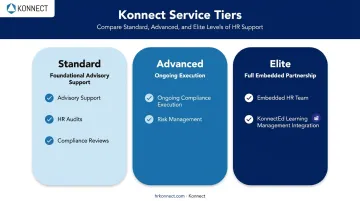
That experience shapes how Konnect structures its service tiers:
- Standard tier: advisory support through HR audits and compliance reviews, ideal for businesses building their first program
- Advanced tier: moves from advising to executing, with ongoing compliance and risk management built in
- Elite tier: a dedicated embedded HR team paired with Compliance Learning Management through KonnectED, powered by Absorb, suited to companies centralizing training across departments and locations
Whether you're a five-person team building your first policy library or a 250-employee company modernizing training across multiple states, Konnect's scalable model is designed to meet you where you are.
Frequently Asked Questions
What is compliance training for employees?
It's structured education on the laws, regulations, and company policies employees need to follow to perform their jobs legally and ethically. Programs typically combine external regulatory requirements with internal company policies.
What are the 5 principles of compliance?
There's no single official "five principles" framework. The Department of Justice evaluates programs on three questions (design, application, effectiveness), while the U.S. Sentencing Guidelines outline seven program elements, including training, monitoring, and consistent discipline.
How often should employees complete compliance training?
Annual refreshers are standard practice across most industries. Some rules, like New York's harassment training mandate, explicitly require yearly completion, while others (including HIPAA) simply require updates after policy changes.
Is compliance training legally required for all businesses?
No. Requirements vary by industry, state, and company size. OSHA safety training is federally mandated where hazards apply, while harassment training thresholds differ by state, such as California's 5-employee minimum versus Maine's 15-employee rule.
Who is responsible for compliance training within an organization?
HR usually manages the program, but responsibility extends to leadership and managers who reinforce expectations day to day. A true culture of compliance requires buy-in at every level, not just a completed module.
What happens if a company fails to provide required compliance training?
Consequences can include regulatory fines, weakened legal defenses in litigation, higher risk of workplace incidents, and reputational damage. OSHA alone can assess penalties exceeding $165,000 for willful or repeated violations tied to safety-training gaps.