Many business owners struggle to keep pace with hiring, compliance, payroll coordination, and culture-building all at once. Common challenges include tracking state-specific employment law, managing employee relations issues without a dedicated team, and juggling multiple vendors just to keep basic HR functions running.
That's driven a surge of interest in "all-in-one" HR services. But the category is confusing. Some providers sell software. Others sell expertise. Many sell a mix, and it's not always clear what you're actually getting.
This guide breaks down what all-in-one HR services really include, how HR software differs from HR service providers, and how to pick the right option for your business. We'll also look at how Konnect approaches this space through executive-level, human-led HR expertise rather than software alone.
Key Takeaways
- One provider can cover compliance, recruiting, payroll support, training, and strategy—cutting vendor gaps and handoff risk.
- HR software runs data and automation; HR service partners supply judgment, coaching, and exception handling software cannot.
- Fit hinges on headcount, industry complexity, and whether you need tech, human expertise, or both.
- Prioritize real HR leadership experience over a long features list.
What Are All-in-One HR Services?
An all-in-one HR service puts one provider in charge of the full employee lifecycle: hiring, onboarding, compliance, payroll, benefits, performance, and offboarding. Instead of juggling multiple vendors, you work with a single point of contact.
There is no single industry-standard definition. In practice, scope follows company size. SHRM research shows smaller employers often outsource entire HR functions—compliance, recruiting, payroll, and benefits administration—while larger employers keep strategic work in-house and outsource transactional pieces (SHRM, 2018).
Software-First vs. Expertise-First
Businesses generally encounter two categories:
- HRIS/HCM platforms — data and automation first: employee records, self-service portals, payroll processing.
- HR service firms — expertise first, staffed by credentialed advisors who handle judgment calls.
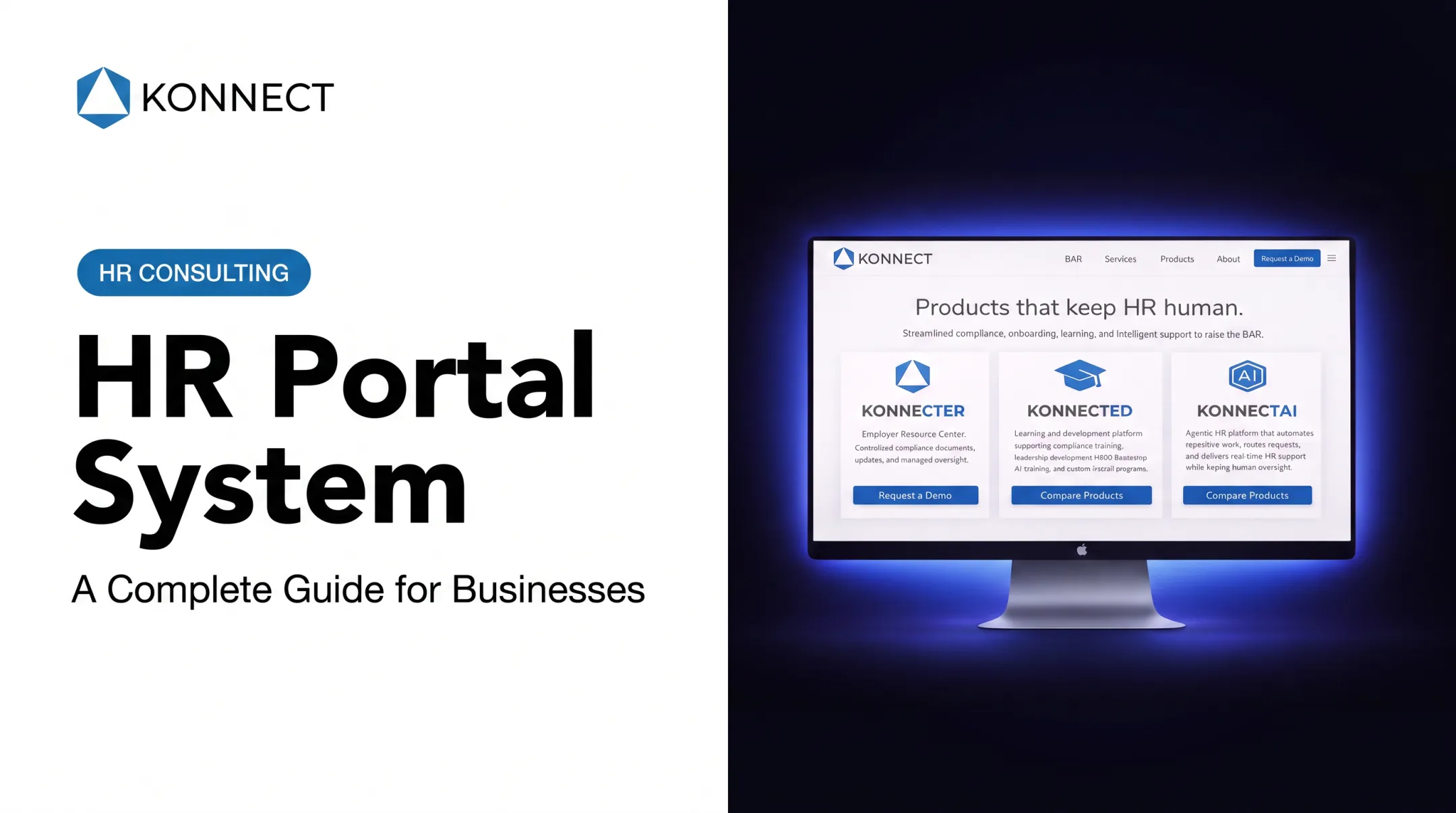
Konnect sits in the second category. Its Center of Excellence model is staffed by former CHROs and senior HR leaders across Talent, Culture, HR Operations, and Total Rewards, with supporting tools such as KonnectAi, KonnectEd, and KonnectER for automation, learning, and policy management.

Growing companies often need both. Software manages the data; human expertise handles the judgment calls, including:
- A termination that could trigger a wrongful termination claim
- An audit finding that needs a clear remediation plan
- A compliance dispute that benefits from CHRO-level experience
What Are Some Examples of HR Services?
HR services generally fall into eight core categories. Here's what each looks like in practice:
- Recruiting and talent acquisition — sourcing, screening, and hiring, including executive search and recruitment research
- Onboarding and offboarding — structured new-hire processes and managed exits, including knowledge transfer and final administration
- Payroll and benefits administration — coordination and oversight to keep pay accurate and compliant
- Compliance and employment law guidance — state-specific handbooks, policy libraries, and required training
- Performance management — frameworks for reviews, goal-setting, and development plans
- Employee relations and conflict resolution — investigating complaints and documenting terminations properly
- Training and development — compliance courses, leadership development, and skills-based learning
- HR strategy and culture consulting — organizational design, workforce planning, and engagement strategy
Specialized industries often need more than generalist support:
- Healthcare — clinical compliance requirements beyond standard employment rules
- Retail — high turnover and shift-based scheduling demands
- Hospitality — sector-specific labor-law nuances
Konnect covers healthcare, retail, hospitality, and nonprofit organizations, matching specialists to each client's sector instead of assigning a generic generalist.

Pricing is not always one package. Some services come bundled at a flat monthly rate, while others, like executive recruiting or compensation analysis, are engagement-based and priced separately. Ask exactly what's included in the base retainer before you commit.
Must-Have Features in an All-in-One HR Service
Not every provider claiming to do "everything" actually delivers. Here's what separates a genuinely comprehensive service from a marketing pitch:
- State-specific, continuously updated compliance coverage. Employment law varies by state (SHRM), and the U.S. Department of Labor requires small businesses to meet federal and state standards on pay, recordkeeping, leave eligibility, and worker notices.
- Access to credentialed, executive-level HR experts for judgment-heavy situations — terminations, misclassification issues, audits — not just templates or a chatbot.
- Scalability that supports a 5-person team and a 250-person enterprise without forcing a platform switch.
- Transparent pricing that spells out what's in the base service versus paid add-ons.
- Industry-specific expertise relevant to your sector, whether that's retail turnover or healthcare shift compliance.
- A people-centered approach that goes beyond transactional support into engagement and retention strategy.
This last point is where many providers fall short. Konnect's founder, Jamie Viramontes, brings 25-plus years of CHRO and VP-level HR experience from Forever 21, UCI Health, Chipotle, and JPMorgan Chase.
That background is harder to replicate with software alone: knowing what a culture problem looks like before it shows up in a turnover report.
Key Benefits of All-in-One HR Services
All-in-one HR tends to show up in three places leaders care about: capacity, risk, and retention.
- Time and cost savings. One provider replaces multiple vendor relationships and frees capacity spent coordinating them. SHRM notes larger organizations outsource transactional work so internal HR can focus on strategic priorities (SHRM, 2018).
- Reduced compliance risk. Proactive guidance is cheaper than cleanup. The Department of Labor's Wage and Hour Division recovered more than $259 million in back wages for nearly 177,000 workers in FY2025 alone—reactive fixes after a violation cost far more than an ongoing audit trail.
- Improved retention and culture. Engagement is harder to quantify than back wages, but it moves the business. After partnering with Konnect, YETI's Senior Director said her team had more room for retail expansion while still "driving employee engagement and fostering a culture of connectivity."

HR Services vs. HR Software: Which Do You Need?
| Need | Best Fit |
|---|---|
| Employee data management, self-service portals, automation at scale | HR software (HRIS/HCM) |
| Strategic guidance, hands-on expertise, complex people decisions | HR service provider |
| Both data management and judgment-based support | Combined approach |
HR software (HRIS or HCM platforms) is built for operational efficiency: storing records, running payroll, automating repetitive tasks. It's excellent at scale, but it doesn't make judgment calls.
HR service providers like Konnect fill that gap. They handle strategy, compliance interpretation, and the messy, human parts of workforce management that software can't touch.
Most growing businesses end up using both: a payroll/HRIS tool for data, paired with an HR service partner for strategy and compliance judgment.
Konnect's own product suite reflects this blend. KonnectAi automates routine HR questions and integrates with platforms like Workday and ADP, while KonnectEd and KonnectER organize training and compliance documents. None of it replaces the advisory layer; it supports it.
How to Choose the Right All-in-One HR Partner
Before signing with any provider, run through this checklist:
- Verify actual HR leadership experience. Ask who's on the team and what roles they've held, not just marketing claims of "doing everything."
- Confirm industry-specific expertise. A retail-heavy team may not understand healthcare shift compliance, and vice versa.
- Check scalability. Can the partnership grow with you from 10 employees to 250 without a disruptive provider switch?
- Ask about tier structure and pricing clarity. Know what's in the base retainer versus what triggers an add-on fee. Konnect's Center of Excellence model shows how those criteria look in practice:
- CHRO- and VP-level leaders assigned by discipline
- Tiered service levels (Standard, Advanced, Elite) that scale with headcount
- Pricing from $499/month for small teams to $5,999/month for enterprise support, plus a one-time audit and setup fee

Frequently Asked Questions
What are some examples of HR services?
Core examples include recruiting, compliance guidance, performance management, employee relations support, training, and strategic HR consulting.
What is the difference between an all-in-one HR platform and an HR service provider?
A platform focuses on data management and automation, like payroll processing or self-service portals. A service provider adds expert-led guidance for strategy, compliance, and complex people decisions.
How much do all-in-one HR services typically cost?
Pricing varies widely. Smaller teams often use flat-rate memberships, while larger or more complex needs use custom engagement pricing. Konnect's tiers, for example, range from $499 to $5,999 per month based on headcount.
Can small businesses benefit from all-in-one HR services?
Yes. Scalable models let small businesses access HR expertise without hiring in-house staff, often starting with a fractional HR manager and growing from there.
Do all-in-one HR services help with compliance?
Yes. Compliance guidance, state-specific policies, and proactive updates are core to most all-in-one HR offerings, helping businesses avoid the cost of reactive fixes.
How do I know if my business needs an HR service provider versus software?
Evaluate whether you need data automation, strategic guidance, or both. Businesses facing complex people decisions need human expertise on top of any software they already use.